


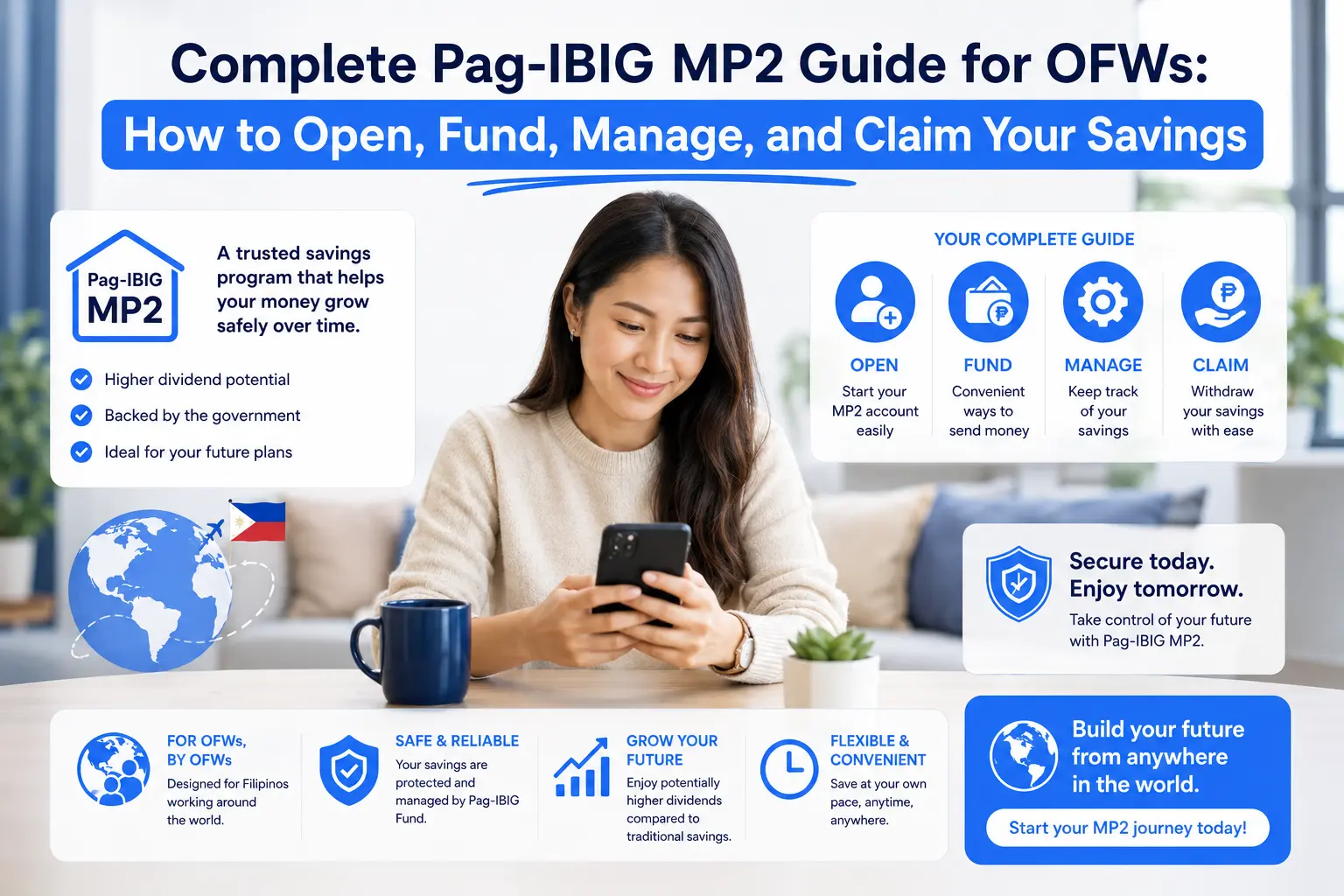
Working abroad can make saving for the future easier in some ways, but it can also make Philippine-based financial accounts harder to manage. You may be earning in a foreign currency, sending money home regularly, and dealing with different payment channels while thousands of miles away from the Philippines.
The Pag-IBIG MP2 Savings Program can be a practical option for overseas Filipino workers (OFWs) who want to set aside part of their income for a medium- to long-term goal.
The good news is that you do not need to return to the Philippines just to open or fund an MP2 account. Eligible members can use Virtual Pag-IBIG and overseas payment facilities to manage their savings from abroad. Pag-IBIG Fund also provides specific payment channels for overseas members.
However, there are a few details OFWs should understand before opening an account, particularly when it comes to payment methods, foreign currency, account records, annual dividends, maturity, and claiming the proceeds while overseas.
This guide walks you through the entire process.
What Is Pag-IBIG MP2?
Modified Pag-IBIG II, commonly called MP2, is a voluntary savings program offered by Pag-IBIG Fund to eligible members.
Unlike your regular Pag-IBIG savings, MP2 is designed as a separate savings account with a five-year maturity period and a dividend rate that is declared annually by Pag-IBIG Fund.
The program allows you to:
- Start saving with at least ₱500
- Make savings payments according to your preferred schedule
- Choose between annual dividend payout or compounded dividends
- Keep the account for five years
- Claim your savings and dividends after maturity
- Open another MP2 account after maturity if you want to continue saving
The current MP2 terms state that the minimum savings is ₱500 and that the five-year period starts from the date of your initial MP2 payment.
For OFWs, the biggest advantage is convenience. You can establish an MP2 account and continue making payments while living and working abroad instead of waiting until your next trip home.
Can OFWs Open a Pag-IBIG MP2 Account?
Yes.
Active Pag-IBIG I members can voluntarily enroll in MP2 regardless of monthly income. The official MP2 terms also include certain former Pag-IBIG I members, pensioners, and former natural-born Filipinos who reacquired Filipino citizenship under Republic Act No. 9225.
For an OFW, the important distinction is that being overseas does not prevent you from participating in MP2.
In fact, Pag-IBIG Fund has dedicated services and payment facilities for overseas members. Virtual Pag-IBIG allows OFWs to open MP2 accounts, remit savings, and view their savings records online.
If you are already a Pag-IBIG member and have your MID number, the process is generally more straightforward.
If you are not yet a Pag-IBIG member, you will need to establish your Pag-IBIG membership first before opening MP2.
How to Open an MP2 Account Online
One of the most useful features for OFWs is the ability to open an MP2 account through Virtual Pag-IBIG without visiting a Philippine branch.
Step 1: Make sure you have your Pag-IBIG membership details
Before starting, prepare your:
- Pag-IBIG Membership ID (MID) number
- Personal information registered with Pag-IBIG
- Active email address
- Mobile phone number
- Valid identification documents, if requested
It is important that your personal information is accurate and up to date.
If your name, address, contact information, or other member details have changed, update your Pag-IBIG records rather than opening an account using outdated information.
Step 2: Access Virtual Pag-IBIG
Go to Virtual Pag-IBIG and log in to your account.
If you have not registered yet, create your Virtual Pag-IBIG account first.
For OFWs, having an active Virtual Pag-IBIG account is particularly useful because it gives you an online way to monitor your Pag-IBIG savings without relying on someone in the Philippines to check your records.
Step 3: Select the MP2 enrollment option
Once logged in, look for the option to open or enroll in an MP2 Savings account.
You will be asked to provide the required information and confirm your agreement with the MP2 terms and conditions.
Before proceeding, make sure you understand the five-year maturity period and the rules surrounding early withdrawal.
Step 4: Choose how you want your dividends handled
You will generally have two choices:
- Annual dividend payout: Receive the declared dividends periodically according to Pag-IBIG’s payout process.
- Compounded dividends: Leave the dividends in the account so they can form part of the balance used for future dividend calculations.
The choice can affect how much you accumulate over the five-year period.
If you want to understand the difference between these options in detail, see our guide on annual payout vs. compounded savings in Pag-IBIG MP2.
For OFWs, there is another practical consideration: how you will receive your annual dividends while overseas.
Pag-IBIG has previously stated that overseas members without a Philippine bank account may receive annual MP2 dividend payouts through check.
Step 5: Make your initial payment
Your MP2 account becomes subject to its five-year term from the date of the initial payment.
The minimum MP2 savings is ₱500.
Once the account is successfully opened and funded, keep your MP2 account number somewhere secure.
You will need the MP2 account number when making payments through certain overseas remittance and payment channels.
What OFWs Need Before Funding MP2
Opening the account is only the first step.
The bigger question for many OFWs is:
How do you actually put money into MP2 when your salary is being paid overseas?
The answer depends on the country where you work and which payment facilities are available to you.
Pag-IBIG Fund supports several payment channels for overseas members, including overseas remittance facilities and online payment options.
Before sending money, prepare these details:
| Information | Why you need it |
|---|---|
| Pag-IBIG MID number | Identifies your Pag-IBIG membership |
| MP2 account number | Identifies your specific MP2 account |
| Registered name | Should match your Pag-IBIG records |
| Payment amount | Minimum MP2 payment is ₱500 |
| Email address | Useful for receipts and transaction records |
| Mobile number | May be required by the payment provider |
Important: Your MP2 account number and Pag-IBIG MID number are not interchangeable.
When paying MP2 through a payment facility, make sure you select MP2 Savings and enter your MP2 Account Number rather than simply entering your MID number. Pag-IBIG’s payment guides specifically identify the MP2 account number as the reference for MP2 payments.
How to Fund Your MP2 Remittances Abroad
There is no requirement to send money to a family member in the Philippines first and ask them to deposit it into your MP2 account.
Depending on your location and available payment facilities, you may be able to pay Pag-IBIG directly.
Option 1: Overseas remittance centers
Pag-IBIG Fund provides overseas payment facilities through participating remittance partners.
For example, PNB’s overseas payment process allows members to make Pag-IBIG payments at participating PNB overseas branches. For MP2 payments, the MP2 account number is used as the account reference, and the remitter receives a PNB Remittance Receipt as proof of payment.
The general process is:
- Find an eligible Pag-IBIG payment or remittance partner in your country.
- Tell the staff that you are making an MP2 Savings payment.
- Provide your MP2 account number.
- Provide the required personal information.
- Pay the amount plus any applicable fees.
- Keep your official receipt or transaction reference.
The exact partners and procedures can vary by country, so check the current Pag-IBIG payment guide or the remittance provider before making a transaction.
Option 2: Online payment facilities
If you have access to an accepted card or digital payment method, you may also be able to make an online Pag-IBIG payment.
Pag-IBIG’s online payment facility supports MP2 Savings payments with a minimum of ₱500. It also allows the member to identify their membership category as local or overseas.
This can be convenient for OFWs who do not want to visit a remittance center.
However, check the applicable convenience fee before confirming the transaction.
Option 3: GCash
GCash can also be used for Pag-IBIG MP2 payments through the supported payment process.
Pag-IBIG’s payment guide lists MP2 Savings among the Pag-IBIG payments that can be made through GCash.
However, OFWs should be careful about one important point:
Being able to access GCash from abroad does not automatically mean funding your GCash wallet from your foreign bank account will be convenient or available.
Your ability to cash in may depend on your account setup, country, bank, and available GCash services.
For the detailed GCash payment procedure, see our guide on how to pay Pag-IBIG MP2 using GCash.
Option 4: Pay in larger amounts
You do not necessarily need to send exactly ₱500 every month.
MP2 is flexible, so an OFW could structure savings around their salary and remittance schedule.
For example:
- ₱500 monthly
- ₱2,500 every five months
- ₱5,000 monthly
- ₱30,000 once or several times a year
- A larger lump-sum contribution when receiving a bonus
The right approach depends on your cash flow.
If you are deciding between making a large deposit and contributing regularly, our lump sum vs. monthly MP2 comparison covers that decision in greater detail.
A note about large MP2 payments
There are additional requirements for large payments.
Under the current MP2 terms, payments exceeding ₱100,000 may require applicable proof of income or source of funds. A one-time MP2 savings payment exceeding ₱500,000 must be made through a personal or manager’s check.
This is especially important for OFWs who receive a large overseas bonus or plan to transfer a substantial amount into MP2.
Do not assume that a large payment can be processed exactly like your regular monthly contribution.
Converting Your Foreign Salary to MP2 Savings
MP2 is denominated in Philippine pesos, so your overseas salary ultimately needs to be converted into pesos before it becomes an MP2 contribution.
This creates a practical consideration for OFWs: foreign exchange costs.
Suppose you earn in Saudi riyals, UAE dirhams, Singapore dollars, Hong Kong dollars, Japanese yen, US dollars, or another foreign currency.
Your actual cost of making an MP2 contribution can vary depending on:
- The exchange rate
- Remittance fees
- Payment provider fees
- Bank charges
- The amount you send
- The payment channel you use
You therefore should not evaluate an MP2 contribution based only on the amount credited to your MP2 account.
Look at the total amount that leaves your foreign account versus the peso amount actually credited to MP2.
For recurring contributions, even a small difference in remittance costs can add up over several years.
How Much Should an OFW Save in MP2?
There is no universal amount that every OFW should contribute.
A better approach is to divide your savings into different purposes.
For example:
| Goal | Possible savings vehicle |
|---|---|
| Emergency expenses | Easily accessible savings |
| Money needed within months | Liquid bank account |
| Medium-term savings | MP2 or similar options |
| Long-term retirement | Retirement-focused investments |
| Family obligations | Separate cash reserve |
This matters because MP2 should not be treated as your emergency fund.
Although the program has provisions for certain pre-termination circumstances, the standard MP2 structure is designed around a five-year term.
Before sending a large portion of your overseas income into MP2, make sure you have enough accessible money for emergencies, family needs, travel, medical expenses, and unexpected job-related costs.
You can use our Pag-IBIG MP2 Savings Calculator to estimate potential savings based on your contribution amount, expected dividend rate, and savings period.
Key MP2 Program Rules OFWs Should Know
The basic MP2 rules apply whether you are working in the Philippines or overseas, but some rules are particularly important for OFWs.
1. The minimum savings is ₱500
You can start MP2 with ₱500.
This does not mean you must limit yourself to ₱500 or necessarily make a payment every month.
The important point is that the minimum MP2 savings amount is ₱500.
2. The maturity period is five years
The five-year term starts from the date of your initial MP2 payment.
This means you should keep track of the actual opening and initial payment date instead of simply assuming that every MP2 account matures at the end of a calendar year.
3. Dividend rates are not fixed
MP2 does not promise one fixed annual interest rate.
The dividend rate is declared after Pag-IBIG Fund calculates its net income and the rate is approved by the Board of Trustees.
This is why you should avoid calculating your future MP2 balance using one guaranteed rate.
A calculator can help you model different scenarios, but actual future dividends can differ.
4. You can choose annual or compounded dividends
MP2 allows you to choose between annual dividend payout and compounded dividend earnings.
The choice is particularly relevant to OFWs.
If you want to use the dividends as part of your annual cash flow while abroad, an annual payout may be useful.
If your goal is to maximize the amount left in the account until maturity, compounding may be more appropriate.
5. You cannot simply withdraw whenever you want
MP2 is not intended to function like an ordinary savings account.
The official terms identify specific circumstances where pre-termination or early withdrawal is allowed, including total disability, certain health-related circumstances, death, retirement, critical illness, permanent departure from the country, certain distressed-member situations, and repatriation of an OFW.
There is an important distinction here for OFWs:
Working abroad does not automatically mean you can withdraw MP2 early.
The terms specifically refer to repatriation of an OFW member from the host country as one of the qualifying circumstances.
6. Early withdrawal can reduce your dividends
If you terminate your MP2 account before maturity for a reason that does not qualify under the permitted circumstances, the terms provide for a penalty involving the dividends earned.
The current terms state that the member is entitled to only 50% of total dividends earned, with additional rules applying if annual dividends have already been received.
This is another reason to avoid putting emergency money into MP2.
7. Your MP2 account does not automatically renew
After five years, you can choose to withdraw your matured savings or continue saving through a new MP2 account.
The current terms state that if you do not withdraw upon maturity, the account stops earning the MP2 dividend rate. It may instead earn dividends based on the Pag-IBIG I rate for the following two years, after which it is reclassified as accounts payable.
Do not assume that an old MP2 account will automatically roll over into another five-year MP2 term.
If you want to continue your savings strategy, you need to apply for a new MP2 account.
For a detailed explanation of reinvesting matured MP2 savings, see our guide to Pag-IBIG MP2 rollovers.
How OFWs Should Manage Their MP2 Account
Opening an MP2 account is easy compared with managing it properly for five years.
For OFWs, the biggest challenge is usually keeping track of payments and account information while living overseas.
Keep your MP2 account number secure
Your MP2 account number is important because it is used when making MP2 payments through applicable payment channels.
Keep a copy somewhere secure, such as:
- A password manager
- An encrypted digital file
- A secure personal finance tracker
- Your financial records
Avoid relying exclusively on screenshots saved on an old phone.
Save every payment receipt
Every time you make an MP2 payment abroad, keep the transaction confirmation.
Create a simple folder containing:
- Payment date
- Payment amount
- Foreign currency amount
- Exchange rate, if available
- Payment provider
- Transaction reference
- MP2 account number
- Receipt or confirmation
This can make it much easier to reconcile your records later.
Check Virtual Pag-IBIG regularly
Virtual Pag-IBIG can be especially valuable for OFWs because you do not need to depend on someone in the Philippines to monitor your account.
Use it to check your savings records and confirm that your transactions are reflected correctly. OFWs can also use Virtual Pag-IBIG to view their MP2 savings and dividends.
If a payment does not appear as expected, keep your receipt and transaction reference before contacting Pag-IBIG.
Update your contact information
OFWs frequently change employers, phone numbers, addresses, or even countries.
Do not forget to keep your Pag-IBIG information updated.
The MP2 terms specifically require members to notify Pag-IBIG Fund when there is a change in information and to accomplish the appropriate Member’s Change of Information Form.
What Happens When Your MP2 Reaches Maturity?
When your five-year MP2 term ends, you generally have two choices:
- Claim the matured savings and dividends.
- Open a new MP2 account if you want to continue saving.
The original account does not simply restart for another five years.
For OFWs, it is worth planning your maturity date in advance.
For example, if your MP2 account matures while you are still working overseas, you do not necessarily need to wait until your next vacation in the Philippines to start planning the claim.
You should check the current claiming process and available disbursement options before maturity.
How OFWs Can Claim Their MP2 Savings
Claiming your MP2 savings is an important part of the process, especially if you will still be overseas when your account matures.
The exact requirements and available disbursement method can depend on your circumstances, so it is best to verify the latest Pag-IBIG instructions before submitting a claim.
You should prepare to provide information such as:
- Your Pag-IBIG membership details
- Your MP2 account number
- Valid identification
- Your preferred or eligible receiving account, if applicable
- Supporting documents required by Pag-IBIG
For the detailed withdrawal process, requirements, and claim instructions, see our complete guide on how to withdraw Pag-IBIG MP2 savings.
What if you do not have a Philippine bank account?
This is an important consideration for OFWs.
Pag-IBIG has previously stated that overseas members who choose annual dividend payout but do not have a Philippine bank account may receive their MP2 dividends through check.
Because payment and claiming procedures can change, do not assume that the process you used several years ago will remain identical.
Before your maturity date, check the current Pag-IBIG requirements and available disbursement options.
What if you need the money before maturity?
Do not assume that being an OFW automatically qualifies you for early withdrawal.
The MP2 terms specifically list repatriation of an OFW member from the host country as a qualifying circumstance. Other qualifying circumstances are also listed, including retirement, certain health conditions, critical illness, death, and other approved grounds.
In 2026, Pag-IBIG Fund also introduced a special relief package for certain repatriated OFWs affected by the Middle East conflict, allowing qualified members to access MP2 savings before the standard five-year maturity. This was a special assistance measure and should not be confused with the ordinary MP2 withdrawal rules.
Always check whether a special program applies to your specific situation rather than assuming it is a permanent MP2 rule.
Should OFWs Use MP2 for Retirement?
MP2 can be useful as part of an OFW’s retirement strategy, but it should not automatically become the only place where you save for retirement.
Your financial situation as an OFW can involve several goals at the same time:
- Building an emergency fund
- Supporting your family
- Buying a home
- Preparing for retirement
- Starting a business after returning home
- Paying for your children’s education
- Building investments outside the Philippines
MP2 can fit into this bigger strategy because of its five-year structure and dividend-based returns.
However, retirement planning should also consider investments with different time horizons, liquidity characteristics, and risk levels.
If you are comparing MP2 with other Philippine retirement options, you can read our guide on Pag-IBIG MP2 vs. PERA for retirement savings.
You can also read our comparison of Pag-IBIG MP2 vs. SSS Pension Booster if you are evaluating additional retirement savings options.
A Simple MP2 Workflow for OFWs
If you want to keep your MP2 strategy simple, use this five-step process:
- Open – Create or access your Virtual Pag-IBIG account and open an MP2 account.
- Fund – Choose an overseas payment channel that works for your country and compare the associated remittance or convenience costs.
- Track – Save every payment receipt and regularly check your MP2 records through Virtual Pag-IBIG.
- Plan – Know your maturity date and decide in advance whether you want to claim the money or open a new MP2 account.
- Claim – When the account matures, follow Pag-IBIG’s current claim requirements and use the applicable disbursement method available to you.
This approach is much easier than trying to reconstruct five years of MP2 transactions when you are finally ready to withdraw.
Common MP2 Mistakes OFWs Should Avoid
- Sending money to the wrong account – Always double-check that the payment is being made to MP2 Savings and that your MP2 account number is correct.
- Assuming ₱500 means monthly – The ₱500 figure is the minimum MP2 savings amount. It does not mean every OFW needs to save exactly ₱500 every month.
- Using MP2 as an emergency fund – Five-year savings products are not a substitute for cash that you may need immediately.
- Ignoring foreign exchange costs – Your remittance provider’s exchange rate and fees can affect the real cost of your MP2 contributions.
- Forgetting the maturity date – Your MP2 account does not automatically restart as a new five-year account when it matures.
- Assuming the dividend rate is guaranteed – MP2 dividends are declared annually and are not a fixed interest rate.
- Losing payment records – Receipts and transaction references can become extremely useful if you need to investigate a missing or incorrectly posted payment.
Final Thoughts
For OFWs, Pag-IBIG MP2 can be more than just a Philippine savings account. It can provide a structured way to set aside part of your overseas income for a future goal while allowing you to manage the account remotely.
The key is understanding the process before you start.
Open the account through Virtual Pag-IBIG, keep your MP2 account number secure, choose an overseas payment method that makes sense for your country, track every remittance, and know when your five-year maturity date arrives.
Most importantly, treat MP2 as part of your overall financial plan rather than as your only savings account. Keep emergency funds accessible, consider the cost of converting and remitting foreign currency, and avoid committing money that you may need before maturity.
For an OFW who can consistently set aside money and leave it invested for the intended period, MP2 can be a straightforward way to build peso-denominated savings even while living and working abroad.
Program rules, payment channels, fees, and claiming procedures can change. Always verify the latest requirements with Pag-IBIG Fund before making a payment or submitting a claim.
Related Articles
If you are building a larger Pag-IBIG MP2 strategy, these guides may also help:
- How to Open a Pag-IBIG MP2 Savings Account
- Annual Payout vs. Compounded Savings in Pag-IBIG MP2
- Lump Sum vs. Monthly: Which Pag-IBIG MP2 Strategy Wins?
- Pag-IBIG MP2 Ladder Strategy
- Pag-IBIG MP2 vs. Digital Banks: Which Is Better for Your Goals?
For the official program rules, review the Pag-IBIG MP2 Savings Terms and Conditions before opening or making a large contribution.