



If you are planning to save ₱300,000 in Pag-IBIG MP2, you have two very different ways to get there.
You could invest the entire ₱300,000 as a lump sum.
Or, if you are building your savings from your monthly income, you could contribute ₱5,000 every month for five years, eventually reaching the same ₱300,000 in total contributions.
At first, these strategies might seem almost identical. After all, both put ₱300,000 into MP2.
But there is one major difference:
The lump-sum investor gets the entire ₱300,000 working from the beginning. The monthly investor builds the balance gradually.
That difference in timing can have a significant effect on potential dividends.
For this article, we will compare both strategies using a hypothetical constant 7% annual dividend rate. This is only for illustration. Actual Pag-IBIG MP2 dividend rates are declared annually and can change from year to year.
Lump Sum vs. Monthly: Quick Comparison
| ₱300,000 Lump Sum | ₱5,000 Monthly | |
|---|---|---|
| Total contributions | ₱300,000 | ₱300,000 |
| Contribution period | Upfront | 60 months |
| Monthly contribution | None | ₱5,000 |
| Amount invested at the start | ₱300,000 | ₱5,000 |
| Potential dividend earnings | Higher | Lower |
| Cash flow impact | Large upfront commitment | Smaller monthly commitment |
| Best for | People with excess cash | People saving from regular income |
In terms of potential returns, the lump sum wins because the money is invested earlier.
But that does not automatically mean everyone should put ₱300,000 into MP2 at once.
The better strategy depends on where the money is coming from and whether investing a large amount upfront would affect your financial security.
Why Does Timing Matter in Pag-IBIG MP2?
The biggest reason timing matters is that MP2 dividends are based on your savings balance and the applicable dividend rate.
If you invest ₱300,000 upfront, the full amount can contribute to your MP2 balance from the beginning of the investment period.
With a ₱5,000 monthly strategy, your balance grows gradually.
After one month, you have ₱5,000.
After six months, you have ₱30,000.
After one year, you have ₱60,000.
It takes the full five years to reach ₱300,000.
How ₱5,000 Monthly Builds to ₱300,000
| Month | Monthly Contribution | Cumulative MP2 Contributions |
|---|---|---|
| 1 | ₱5,000 | ₱5,000 |
| 2 | ₱5,000 | ₱10,000 |
| 3 | ₱5,000 | ₱15,000 |
| 6 | ₱5,000 | ₱30,000 |
| 12 | ₱5,000 | ₱60,000 |
| 24 | ₱5,000 | ₱120,000 |
| 36 | ₱5,000 | ₱180,000 |
| 48 | ₱5,000 | ₱240,000 |
| 60 | ₱5,000 | ₱300,000 |
This is the central difference between the two strategies.
The lump-sum investor has ₱300,000 working in MP2 from the start.
The monthly investor has only ₱5,000 working at the beginning, and the balance increases by another ₱5,000 each month.
Lump-Sum Investment
A lump-sum strategy means investing a larger amount into MP2 upfront.
In our example, the investor deposits ₱300,000 at the beginning and leaves it invested for five years.
Potential Returns
The main advantage is simple:
More money is invested sooner.
For illustration, if the MP2 dividend rate were a constant 7% every year and dividends were compounded:
₱300,000 × (1.07)⁵ = approximately ₱420,766
That means the estimated dividends would be approximately:
₱420,766 – ₱300,000 = ₱120,766
Again, this is a simplified illustration, not a guaranteed MP2 maturity value.
Actual dividend rates can change each year, and actual MP2 calculations are more specific than simply applying a fixed annual rate to the starting balance.
Convenience
Once the ₱300,000 has been deposited, there is no need to make another monthly contribution to reach the target.
The money can remain invested while you focus on other financial goals.
The downside is that you have immediately committed ₱300,000.
Best for
A lump-sum strategy may make sense if you:
- Already have ₱300,000 available
- Have a separate emergency fund
- Do not need the money for upcoming expenses
- Have already addressed high-interest debt
- Are comfortable leaving the money invested for the MP2 term
- Want to maximize the amount invested as early as possible
The biggest disadvantage
The biggest concern with lump sum is liquidity.
If ₱300,000 represents most of your savings, putting the entire amount into MP2 could leave you without enough accessible cash for emergencies.
The higher potential dividend may not be worth it if you later need to borrow money because you no longer have enough cash available.
Lump-Sum Scenario: ₱300,000
The following example assumes:
- ₱300,000 invested upfront
- Five-year investment period
- 7% hypothetical annual dividend rate
- Dividends compounded annually
- No additional contributions
| Year | Starting Balance | Estimated Dividend at 7% | Ending Balance |
|---|---|---|---|
| 1 | ₱300,000 | ₱21,000 | ₱321,000 |
| 2 | ₱321,000 | ₱22,470 | ₱343,470 |
| 3 | ₱343,470 | ₱24,043 | ₱367,513 |
| 4 | ₱367,513 | ₱25,726 | ₱393,239 |
| 5 | ₱393,239 | ₱27,527 | ₱420,766 |
Total contributions: ₱300,000
Estimated dividends: ₱120,766
Estimated value after five years: ₱420,766
The advantage is that the entire ₱300,000 is earning from the beginning.
Monthly Contributions
A monthly contribution strategy works differently.
Instead of needing ₱300,000 upfront, the investor commits ₱5,000 every month.
After 60 months:
₱5,000 × 60 = ₱300,000
The investor eventually contributes the same amount as the lump-sum investor.
The major difference is that the money enters MP2 gradually.
Potential Returns
The first ₱5,000 has much more time to earn dividends than the final ₱5,000 contribution.
This means you cannot simply calculate the monthly strategy as:
₱300,000 × 7% × 5 years
That would incorrectly assume the entire ₱300,000 was invested for the full five years.
Instead, the balance grows throughout the five-year period.
This is why monthly contributions can produce lower total dividends even though the investor eventually contributes the exact same amount.
Convenience
Monthly contributions have a major advantage for people who do not already have a large amount of cash.
You can build your MP2 savings directly from your salary.
Instead of finding ₱300,000 today, you only need to commit ₱5,000 each month.
For many savers, this is much easier to manage.
Best for
Monthly contributions may be better if you:
- Do not have ₱300,000 available today
- Are saving from your monthly income
- Want to preserve cash for emergencies
- Prefer a smaller recurring commitment
- Are still building your overall savings
- Want to make investing part of your regular budget
Monthly Contribution Scenario: ₱5,000 for Five Years
For illustration, assume a constant 7% annual dividend rate.
Because contributions are made throughout each year, the estimated dividend is based on the average monthly balance for that year.
| Year | Annual Contributions | Average Monthly Balance* | Estimated Dividend | Estimated Ending Balance |
|---|---|---|---|---|
| 1 | ₱60,000 | ₱32,500 | ₱2,275 | ₱62,275 |
| 2 | ₱60,000 | ₱94,775 | ₱6,634 | ₱128,909 |
| 3 | ₱60,000 | ₱161,409 | ₱11,299 | ₱200,208 |
| 4 | ₱60,000 | ₱232,708 | ₱16,290 | ₱276,497 |
| 5 | ₱60,000 | ₱308,997 | ₱21,630 | ₱358,127 |
*Simplified illustration based on monthly contributions and a constant 7% annual dividend rate.
Total contributions: ₱300,000
Estimated dividends: approximately ₱58,127
Estimated value after five years: approximately ₱358,127
The monthly investor contributes exactly the same ₱300,000 as the lump-sum investor, but the estimated maturity value is lower because the money enters MP2 gradually.
The Real Comparison: ₱300K Lump Sum vs. ₱5K Monthly
Now we can finally answer the question at the heart of this article.
What happens when two investors contribute the same ₱300,000, but one invests it upfront and the other spreads it over five years?
Using our simplified 7% illustration:
| ₱300,000 Lump Sum | ₱5,000 Monthly | |
|---|---|---|
| Total contributions | ₱300,000 | ₱300,000 |
| Investment period | 5 years | 5 years |
| Contribution schedule | Upfront | ₱5,000 × 60 months |
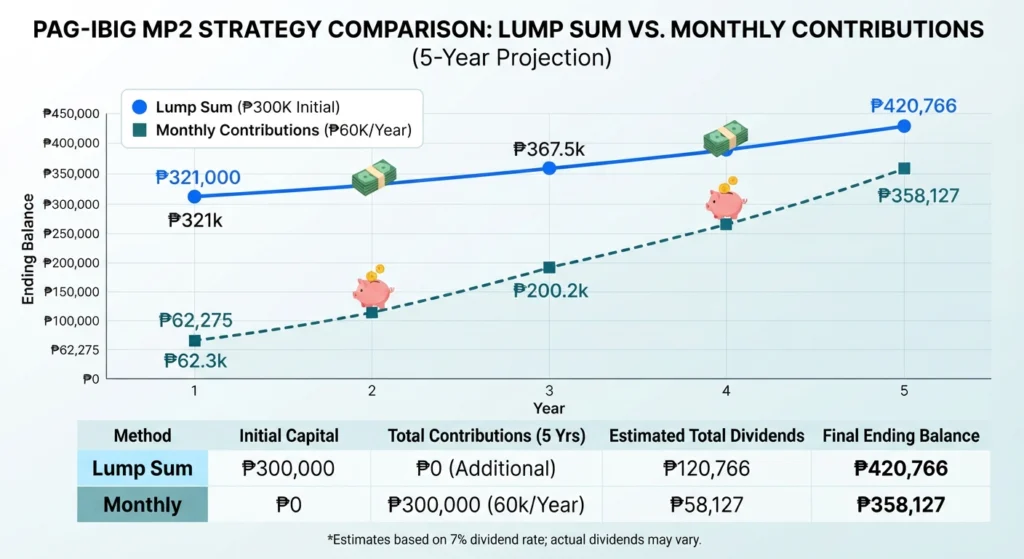
| Estimated dividends | ₱120,766 | ₱58,127 |
| Estimated maturity value | ₱420,766 | ₱358,127 |
| Difference in estimated dividends | ₱62,639 more | — |
Under this simplified scenario, the lump-sum strategy produces approximately ₱62,639 more in dividends.
That is a meaningful difference.
But there is an important reason for it.
The lump-sum investor did not somehow receive a better dividend rate.
The investor simply had more money invested earlier.
Why the Lump Sum Wins
Think of it this way.
Investor A has ₱300,000 today.
Investor B does not.
Investor A puts the entire ₱300,000 into MP2.
Investor B has to build the same ₱300,000 through ₱5,000 monthly contributions.
During the first year, Investor A has approximately ₱300,000 working in MP2.
Investor B is gradually building from ₱5,000 to ₱60,000.
During the second year, Investor A continues to have the accumulated balance working.
Investor B is still building toward the target.
This creates a compounding advantage for the lump-sum investor.
The earlier the money enters the investment, the more opportunity it has to earn dividends.
But Does That Mean You Should Always Choose Lump Sum?
No.
This is where the comparison needs some context.
The lump-sum strategy produces the higher potential return only if you already have the ₱300,000 available.
That is a major distinction.
Someone with ₱300,000 sitting in excess savings can compare:
“Should I invest this ₱300,000 now or gradually contribute it?”
Someone who has ₱5,000 available each month does not have the same choice.
Their realistic question is:
“How much should I contribute to MP2 each month?”
For that person, waiting five years to accumulate ₱300,000 before investing it would actually mean keeping money out of MP2 for longer.
When Lump Sum Makes More Sense
A lump sum can be attractive when you have excess cash that you do not need in the near future.
For example, suppose you have:
- A fully funded emergency fund
- No expensive consumer debt
- Money set aside for your short-term expenses
- An additional ₱300,000 that you are comfortable investing long term
In that situation, investing the ₱300,000 earlier could make sense.
You are putting money to work sooner rather than waiting several years to build the same balance.
When Monthly Contributions Make More Sense
Monthly contributions can be the better choice when investing ₱300,000 upfront would leave you financially stretched.
Suppose you have ₱350,000 in total savings.
Putting ₱300,000 into MP2 would leave only ₱50,000 accessible.
That might not provide enough flexibility for unexpected expenses.
Instead, you could keep your cash reserves intact and contribute ₱5,000 per month.
You would potentially earn less from MP2 than someone who invested ₱300,000 upfront, but you would have much more liquidity.
A lower investment return can sometimes be worth the added financial flexibility.
The Hybrid Strategy
You also do not have to choose between 100% lump sum and 100% monthly contributions.
A hybrid approach can give you some of the benefits of both.
For example, if you have ₱300,000 available, you could invest:
₱150,000 upfront + ₱5,000 monthly
This gets some money into MP2 immediately while allowing you to keep a portion of your cash available.
You could also use bonuses, tax refunds, or other unexpected income to make additional MP2 contributions.
The right split depends on your overall financial situation.
What About the Actual MP2 Dividend Rate?
The 7% rate used in these examples is not a guaranteed MP2 dividend rate.
Pag-IBIG Fund declares MP2 dividend rates annually, so the actual rate can be higher or lower in future years.
The latest declared rate was 7.12% for 2025.
That means you should not treat the estimated ₱420,766 or ₱358,127 figures as guaranteed maturity amounts.
The purpose of the examples is to demonstrate the effect of contribution timing.
The exact difference between the strategies will change depending on the dividend rates declared during the five-year period.
For official information about the program, requirements, and current MP2 guidelines, visit the Pag-IBIG Fund MP2 Savings Program.
What About Annual Payout vs. Compounding?
Contribution timing is only one part of the MP2 equation.
You also need to decide whether you want your dividends paid annually or compounded within your MP2 savings.
With annual payout, dividends are distributed to you instead of remaining in the account.
With compounding, the dividends stay invested and can contribute to future dividend earnings.
If your goal is to maximize the amount accumulated by the end of the term and you do not need the annual income, compounding can potentially produce a higher final balance.
You can learn more about the difference in our guide to annual payout vs. compounded savings in Pag-IBIG MP2.
Use the Pag-IBIG MP2 Savings Calculator
Want to see how different contribution strategies could affect your potential MP2 savings?
Try the Pag-IBIG MP2 Savings Calculator and compare different starting amounts, monthly contributions, dividend rates, and investment periods.
For example, you can compare:
- ₱300,000 lump sum
- ₱5,000 monthly
- ₱10,000 monthly
- A lump sum plus monthly contributions
- Different assumed dividend rates
- Annual payout versus compounded dividends
Running several scenarios can help you determine which strategy fits your own budget instead of relying on a generic recommendation.
Other Pag-IBIG MP2 Strategies to Consider
Your contribution schedule does not have to be your only strategy.
Some savers use an MP2 ladder strategy, where they open different MP2 accounts at different times. This can help create multiple maturity dates instead of having all of your MP2 savings mature at once.
If that approach interests you, read our guide to the Pag-IBIG MP2 ladder strategy.
Frequently Asked Questions
Is a lump sum better than monthly contributions in MP2?
If you already have the full amount available, a lump sum generally has the potential to earn more because the money is invested earlier.
In our ₱300,000 example, the lump-sum strategy produced approximately ₱62,639 more in estimated dividends than investing the same total amount at ₱5,000 per month under a simplified constant 7% assumption.
Is ₱5,000 per month enough for MP2?
Yes. The amount you contribute should be based on what you can comfortably afford.
The advantage of monthly contributions is that you can build your MP2 savings gradually instead of needing a large amount upfront.
What if I have ₱300,000 available but I am not sure whether to invest it all?
Look at your overall financial position first.
If the ₱300,000 is excess money and you already have adequate emergency savings, investing a larger amount earlier can potentially increase your MP2 dividends.
If that ₱300,000 represents most of your accessible savings, keeping more cash available may be more appropriate.
Can I combine a lump sum and monthly contributions?
Yes. You can make an initial contribution and continue making additional contributions.
A hybrid approach can be useful if you have some cash available now but also want to continue building your MP2 balance from your monthly income.
Are MP2 dividend rates guaranteed?
No. MP2 dividend rates are declared annually and can change.
The 7% rate used throughout this article is a hypothetical rate for comparison purposes.
Should I put my entire savings into MP2?
Not necessarily.
MP2 is intended as a long-term savings vehicle, so money that you may need for emergencies or near-term expenses should generally remain accessible.
Before making a large lump-sum contribution, make sure you have enough cash available for your other financial needs.
Final Verdict: Which MP2 Strategy Wins?
If we look strictly at potential MP2 returns, the lump-sum strategy wins.
In our example, both investors contribute exactly ₱300,000 over five years.
But their contribution schedules are very different:
Lump sum: ₱300,000 upfront
Monthly: ₱5,000 every month for 60 months
Using a hypothetical constant 7% annual dividend rate, the lump-sum strategy produces an estimated maturity value of approximately ₱420,766, compared with approximately ₱358,127 for the monthly strategy.
That is a difference of roughly ₱62,639 in estimated dividends.
But the numbers do not tell the whole story.
The lump-sum investor needs to have ₱300,000 available today.
The monthly investor does not.
Choose lump sum if:
- You already have the money available.
- Your emergency fund is adequately funded.
- You do not need the money for short-term expenses.
- You are comfortable keeping the money invested for the MP2 term.
- Your priority is maximizing the amount of money working in MP2 as early as possible.
Choose monthly contributions if:
- You are building your savings from your salary.
- You do not have ₱300,000 available upfront.
- You want to preserve more cash.
- You are still building your emergency fund.
- A smaller recurring contribution fits your budget better.
Consider a hybrid approach if:
- You have some excess cash available.
- You want part of your money invested immediately.
- You also want to continue contributing from your monthly income.
So, which Pag-IBIG MP2 strategy wins?
Lump sum wins on potential returns when you already have the money available. Monthly contributions win on accessibility and cash-flow flexibility.
The best strategy is not necessarily the one that produces the biggest number on a calculator. It is the one that allows you to grow your MP2 savings while still keeping your overall finances healthy.
If you have ₱300,000 sitting in excess cash and do not need it for the foreseeable future, investing earlier may give your money a better opportunity to earn dividends.
If you need to build that ₱300,000 from your monthly income, there is nothing wrong with contributing ₱5,000 at a time.
Starting consistently is more important than waiting until you have the “perfect” amount to invest.