


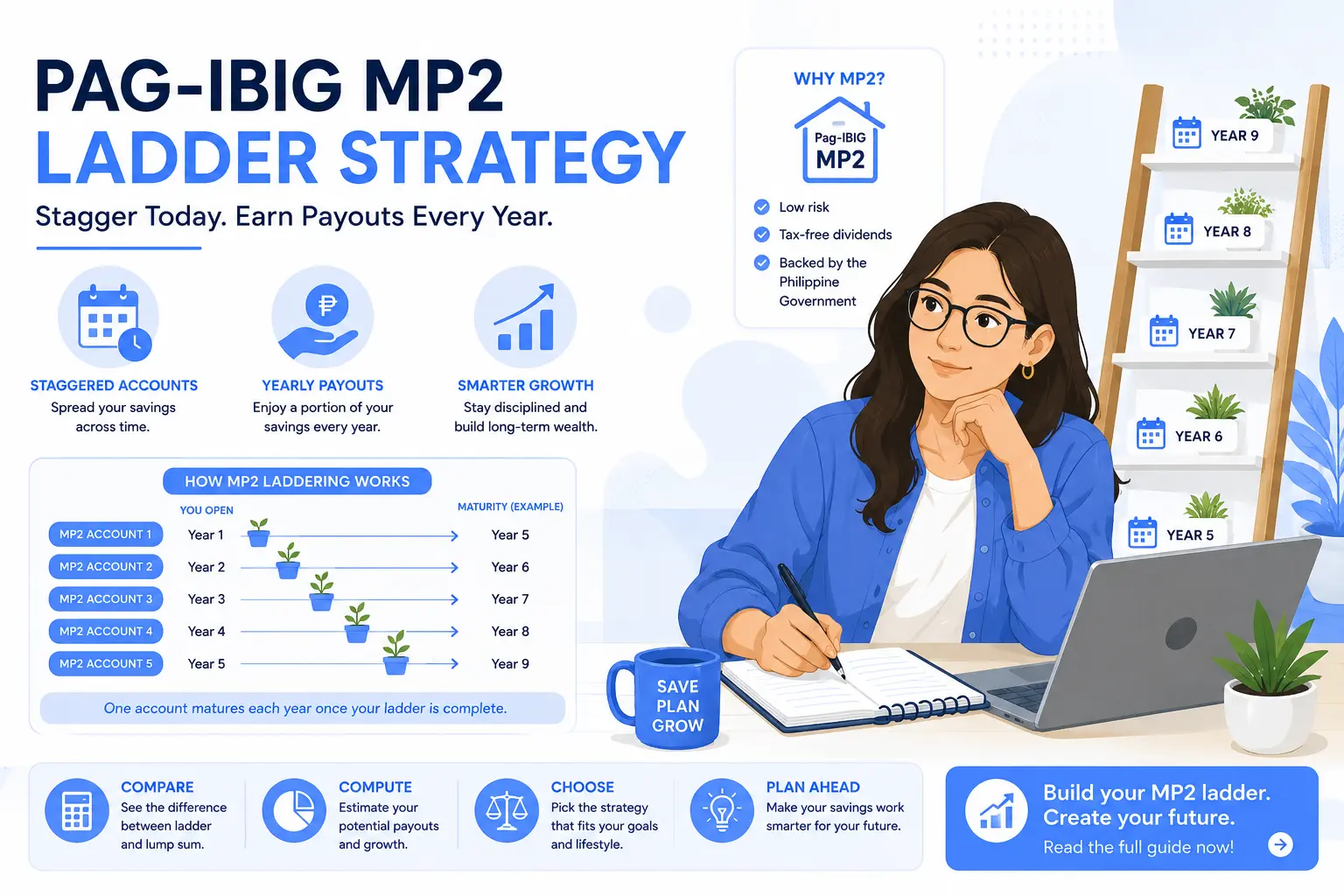
Pag-IBIG MP2 is often discussed as a simple five-year savings option: put money in, wait for the account to mature, and collect your savings plus dividends. But what if you want your MP2 savings to give you access to a portion of your money every year instead of having everything tied up until the same maturity date?
This is where a Pag-IBIG MP2 ladder strategy can be useful.
MP2 laddering, also called an MP2 ladderized or staggered strategy, involves opening multiple MP2 accounts at different times so their five-year maturity dates are spread across different years. Instead of having one large account mature at once, you can structure your savings so that an account reaches maturity each year once the ladder is fully established.
The strategy can be especially appealing if you want to build a predictable cycle of savings maturities while still taking advantage of MP2’s five-year savings period.
Pag-IBIG Fund’s MP2 terms provide for a five-year membership term, and members can choose between annual dividend payout and compounded dividend earnings.
This guide explains how MP2 laddering works, how to build one, its advantages and disadvantages, and how it compares with putting the same amount into one MP2 account.
Important: Dividend rates are not guaranteed and may change from year to year. The calculations in this article use an assumed dividend rate for illustration only. Actual MP2 dividends may differ based on the rate declared by Pag-IBIG Fund and the timing and amount of your savings.
What Is the Pag-IBIG MP2 Laddering Strategy?
The Pag-IBIG MP2 laddering strategy is a savings approach where you open separate MP2 accounts at staggered intervals instead of putting all your savings into a single account at the same time.
The idea is simple.
Suppose you have ₱500,000 available for MP2 savings. Instead of putting the entire amount into one MP2 account, you could divide it into five ₱100,000 accounts and open one account each year.
Each MP2 account has its own five-year maturity period.
For example:
| Account | Amount | Opened | Matures |
|---|---|---|---|
| MP2 Account 1 | ₱100,000 | Year 1 | Year 6 |
| MP2 Account 2 | ₱100,000 | Year 2 | Year 7 |
| MP2 Account 3 | ₱100,000 | Year 3 | Year 8 |
| MP2 Account 4 | ₱100,000 | Year 4 | Year 9 |
| MP2 Account 5 | ₱100,000 | Year 5 | Year 10 |
Once the ladder is fully established, an MP2 account can mature every year.
This is the key difference between laddering and simply opening one MP2 account.
With one large account, your savings have one maturity date. With a laddered strategy, your savings are spread across multiple maturity dates.
Why Would You Ladder MP2 Accounts?
The main reason is liquidity.
MP2 is designed as a five-year savings program. If you put ₱500,000 into one account, you generally need to wait until that account reaches maturity before accessing the savings under the normal maturity process.
With an MP2 ladder, you can potentially have a portion of your savings mature each year.
This can make the strategy useful for people who want to:
- Create a yearly savings maturity cycle
- Fund future expenses
- Build a retirement income strategy
- Receive larger amounts periodically
- Reinvest matured MP2 savings
- Avoid having all MP2 savings locked into one maturity year
- Create a recurring savings and reinvestment system
The strategy does not change the basic MP2 rules. Instead, it uses multiple MP2 accounts with different start dates to create staggered maturity dates.
How the MP2 Laddering Method Works
The easiest way to understand MP2 laddering is to think of it as a five-rung ladder.
Each “rung” represents a separate MP2 account.
Because an MP2 account has a five-year maturity period, you can create a staggered structure by opening an account at regular intervals.
Example: ₱500,000 MP2 Ladder
Let’s assume you have ₱500,000 that you want to allocate to MP2.
You could divide it into five accounts:
- Account 1: ₱100,000
- Account 2: ₱100,000
- Account 3: ₱100,000
- Account 4: ₱100,000
- Account 5: ₱100,000
You then open the accounts one year apart.
Your ladder would look like this:
| Year | Action | Active MP2 Accounts |
|---|---|---|
| Year 1 | Open Account 1 | 1 |
| Year 2 | Open Account 2 | 2 |
| Year 3 | Open Account 3 | 3 |
| Year 4 | Open Account 4 | 4 |
| Year 5 | Open Account 5 | 5 |
| Year 6 | Account 1 matures | 5 |
| Year 7 | Account 2 matures | 5 |
| Year 8 | Account 3 matures | 5 |
| Year 9 | Account 4 matures | 5 |
| Year 10 | Account 5 matures | 5 |
After the initial five-year setup period, you have an account maturing each year.
You could then choose to:
- Withdraw the matured savings.
- Use the money for a planned expense.
- Reinvest some or all of the proceeds into a new MP2 account.
- Combine the proceeds with new savings.
- Adjust the amount of the next account depending on your financial goals.
This creates a repeating cycle.
MP2 Laddering Timeline
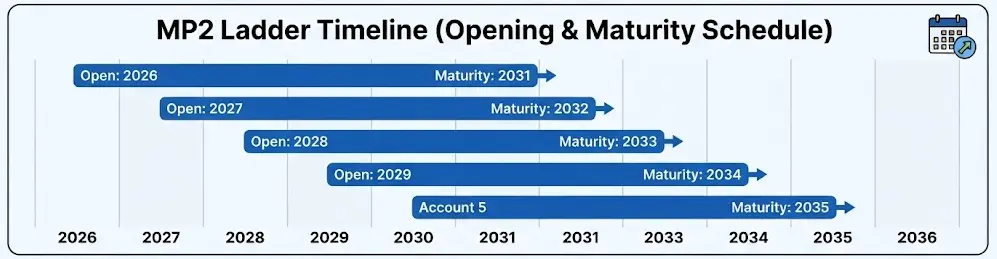
Imagine you start in 2026:
| MP2 Account | Opening Year | Maturity Year |
|---|---|---|
| Account 1 | 2026 | 2031 |
| Account 2 | 2027 | 2032 |
| Account 3 | 2028 | 2033 |
| Account 4 | 2029 | 2034 |
| Account 5 | 2030 | 2035 |
Beginning in 2031, one account reaches maturity each year.
You Do Not Need to Put the Same Amount Into Every Account
A common misconception is that an MP2 ladder must contain equal amounts.
It does not have to.
For example, you could create a ladder like this:
| Account | Contribution |
|---|---|
| Account 1 | ₱200,000 |
| Account 2 | ₱150,000 |
| Account 3 | ₱100,000 |
| Account 4 | ₱75,000 |
| Account 5 | ₱50,000 |
| Total | ₱575,000 |
This creates different maturity amounts.
That may actually be more appropriate if your future financial needs are not identical every year.
For example, you might want a larger maturity amount in the year you plan to make a major purchase and smaller amounts in other years.
Annual Dividend Payout vs. MP2 Laddering
It is important to distinguish annual dividend payout from laddering.
These are two different features or strategies.
Pag-IBIG’s MP2 enrollment terms state that members may choose either annual dividend payout or compounded dividend earnings.
With annual payout, dividends are paid out periodically instead of being retained in the MP2 account to compound.
With laddering, the objective is to stagger the maturity dates of separate MP2 accounts.
You can therefore think of them as two separate decisions:
- Dividend option: Do you want dividends paid annually or compounded?
- Ladder structure: Do you want multiple accounts with staggered maturity dates?
For example, you could have five laddered MP2 accounts and choose the same dividend option for each account.
If you want to understand the difference between annual payouts and compounded MP2 savings in greater detail, see our guide on annual payout vs. compounded savings in Pag-IBIG MP2.
Clear Sample Computation: ₱100,000 Per MP2 Account
Let’s use a simple example to see how the numbers work.
Assume:
- Initial savings per account: ₱100,000
- Five separate MP2 accounts
- One account opened every year
- Assumed dividend rate: 7%
- Dividends are compounded
- The 7% rate remains constant for illustration
The assumed rate is not a prediction of future MP2 dividends.
One Account
If you invest ₱100,000 and assume a constant 7% annual dividend rate with annual compounding:
Year 1
₱100,000 × 1.07 = ₱107,000
Year 2
₱107,000 × 1.07 = ₱114,490
Year 3
₱114,490 × 1.07 = ₱122,504.30
Year 4
₱122,504.30 × 1.07 = ₱131,079.60
Year 5
₱131,079.60 × 1.07 = approximately ₱140,255.17
So, under this simplified illustration, a ₱100,000 account could grow to approximately ₱140,255 after five years.
Actual MP2 calculations are not guaranteed to follow this exact pattern because the dividend rate is declared by Pag-IBIG Fund and may vary.
Five-Account Ladder
Now suppose you open five ₱100,000 accounts one year apart.
Account 1 gets the full five-year period.
Account 2 is opened one year later.
Account 3 is opened two years later.
And so on.
At the end of Year 5, your accounts would have had different amounts of time to earn dividends:
| Account | Starting Amount | Years Invested by Year 5 | Illustrative Value at 7% |
|---|---|---|---|
| Account 1 | ₱100,000 | 5 | ₱140,255 |
| Account 2 | ₱100,000 | 4 | ₱131,080 |
| Account 3 | ₱100,000 | 3 | ₱122,504 |
| Account 4 | ₱100,000 | 2 | ₱114,490 |
| Account 5 | ₱100,000 | 1 | ₱107,000 |
| Total | ₱500,000 | ₱615,329 |
Again, this is a simplified illustration using a constant 7% annual rate.
The important point is not the exact projected amount. It is the structure.
The first account has had five years to grow, while the newest account has only had one year.
Eventually, once each account reaches its own five-year maturity date, you can have a recurring maturity schedule.
What Happens After the First MP2 Account Matures?
This is where the ladder becomes more interesting.
Suppose Account 1 matures in 2031 with an illustrative value of ₱140,255.
You have several options.
Option 1: Withdraw the Money
You can use the matured savings and dividends for your financial goals.
For example, you could use the money for:
- A home renovation
- Education
- A major purchase
- Travel
- Retirement expenses
- Emergency financial needs
- Another investment
Option 2: Reinvest the Entire Amount
You could also use the maturity proceeds to start another MP2 account.
If you reinvest approximately ₱140,255, your next account could become a larger rung in the ladder.
This can create a cycle where matured MP2 accounts are continuously replaced with new accounts.
Option 3: Withdraw Part and Reinvest Part
You do not necessarily have to treat the maturity proceeds as an all-or-nothing decision.
For example:
Maturity proceeds: ₱140,255
Withdraw: ₱40,255
Reinvest: ₱100,000
This gives you both liquidity and continued exposure to MP2 savings.
The exact amount and timing should depend on your financial goals and the rules applicable when you make the transaction.
Pros of the MP2 Laddering Strategy
1. Creates Staggered Maturity Dates
The biggest advantage is straightforward: your MP2 savings do not all mature at once.
Once the ladder is established, you can potentially have an MP2 account reaching maturity each year.
This can be useful for people who want predictable access to portions of their long-term savings.
2. Provides More Flexibility
A single ₱500,000 MP2 account gives you one large maturity event.
A ladder could instead give you several smaller maturity events.
This can make it easier to match your savings with future expenses.
3. Can Support a Long-Term Income Strategy
For someone planning ahead for retirement, a ladderized MP2 strategy could become part of a broader income plan.
For example, you might structure your savings so that different MP2 accounts mature in different years.
The maturity proceeds could then supplement other sources of income.
MP2 should not be treated as a guaranteed annual income product, however. Dividend rates can change, and the timing of account maturity depends on when each account was opened.
4. Reduces the Need to Time One Large Maturity
With one large account, you could end up with your entire MP2 balance maturing during a year when you do not actually need the money.
A ladder gives you more opportunities to decide what to do with the proceeds.
5. Encourages Consistent Saving
The laddering approach can also work well for people who prefer a structured savings routine.
Instead of trying to find a large lump sum every few years, you can establish a schedule for opening and funding accounts.
6. Makes Reinvestment More Systematic
Once your ladder is mature, you can create a repeating process:
Account matures → receive proceeds → withdraw or reinvest → new account joins the ladder.
This can turn MP2 into a long-term savings cycle rather than a one-time five-year investment.
Cons and Considerations
MP2 laddering is not automatically better than putting your money into one account.
There are several trade-offs to consider.
1. Your Money Is Invested Later
If you already have ₱500,000 available today, putting ₱500,000 into MP2 immediately gives the entire amount more time to potentially earn dividends.
With laddering, some of the money remains outside MP2 until you open the next accounts.
That means laddering can produce lower total earnings than a same-day lump-sum investment when the entire amount is available from the beginning.
This is one of the most important considerations.
2. Dividend Rates Can Change
MP2 dividend rates are not fixed for the entire five-year period.
Pag-IBIG’s terms describe MP2 dividends as flexible rates that are declared after the Fund’s net income has been computed and approved.
That means you should not build your financial plan around a guaranteed 7%, 8%, or any other assumed annual rate.
3. You Need to Track Multiple Accounts
A ladderized strategy means more administrative work.
Instead of monitoring one MP2 account, you may have several accounts with different:
- Account numbers
- Opening dates
- Maturity dates
- Contributions
- Dividend choices
- Withdrawal or reinvestment decisions
Keeping a simple spreadsheet or tracker can make this much easier.
4. Laddering Does Not Create Extra Yield
Opening five accounts instead of one does not magically increase the MP2 dividend rate.
If the same amount of money is invested for the same amount of time at the same effective rate, the account structure itself does not create additional returns.
The primary benefit is timing and liquidity, not a higher interest rate.
5. You Need to Plan What Happens at Maturity
A ladder works best when you already know what you want to do with each maturity.
Will you:
- Withdraw everything?
- Reinvest everything?
- Take the dividends?
- Use the proceeds for expenses?
- Build a new five-year ladder?
Without a plan, the ladder can become difficult to manage.
6. Pre-Termination Rules Matter
MP2 is designed as a five-year savings program, and early withdrawal can have consequences.
Pag-IBIG’s MP2 enrollment terms specify circumstances under which pre-termination is allowed and state that other forms of early termination can result in a penalty involving the dividends earned.
This is another reason not to put your entire emergency fund into MP2.
MP2 Ladder vs. Lump Sum: Which Is Better?
The answer depends on what you are trying to accomplish.
If you have a large amount of money available today and your only goal is to maximize the time that money is invested, a lump sum may have an advantage.
If your priority is creating staggered maturity dates and improving access to portions of your savings over time, laddering may be more suitable.
Here is a simple comparison:
| Factor | MP2 Ladder | Lump Sum MP2 |
|---|---|---|
| Initial investment | Split across accounts | Invested at once |
| Maturity | Staggered | One maturity date |
| Liquidity | More predictable after ladder is established | Concentrated at one maturity |
| Administration | More accounts to track | Easier to manage |
| Time invested | Later deposits have less time to earn | Entire amount starts earning sooner |
| Potential total earnings | Can be lower if funds are invested later | Potentially higher if the full amount is invested immediately |
| Best for | Staggered access and planned cash flow | Maximizing time invested |
| Reinvestment | Can be done annually | Usually done at maturity |
Simple Lump-Sum Computation
Suppose you have ₱500,000 today and assume a constant 7% annual compounded dividend for five years.
The simplified calculation would be:
₱500,000 × (1.07)⁵ = approximately ₱701,275
That means the hypothetical growth would be approximately:
₱701,275 − ₱500,000 = ₱201,275
Compare this with the staggered example above.
At the end of Year 5, the five ₱100,000 deposits have different investment periods because they were not all deposited on Day 1.
The lump sum therefore has a mathematical advantage in this specific scenario because the entire ₱500,000 gets more time in the account.
But that does not make the ladder useless.
The ladder solves a different problem.
It is designed around when you want your money to become available, not simply how quickly the entire starting amount can compound.
When Does an MP2 Ladder Make More Sense?
An MP2 ladder may be worth considering if you have long-term savings and want to create a predictable schedule of future maturities.
For example, imagine you are planning for future expenses over the next 10 years.
Instead of having:
₱500,000 → one maturity date
you could eventually structure your savings around:
₱100,000+ → maturity every year
This may make it easier to align your savings with recurring financial goals.
A ladder may be particularly useful if you expect to need money periodically rather than all at once.
On the other hand, if you have ₱500,000 sitting in cash today and know that you will not need it for five years, splitting it into five future deposits may not make as much sense purely from a compounding perspective.
The decision should therefore start with your cash-flow needs, not just the expected dividend rate.
How to Build Your Own Pag-IBIG MP2 Ladder
You can follow a simple process.
Step 1: Decide How Much You Want to Allocate
Start by determining the amount you can comfortably dedicate to long-term savings.
Do not use money that you may need for immediate expenses.
Step 2: Decide How Many Rungs You Want
A traditional MP2 ladder can use five accounts because the MP2 maturity period is five years.
You could structure it as:
- 3 accounts
- 4 accounts
- 5 accounts
- More than 5 accounts
The more accounts you use, the more staggered your eventual maturity schedule can become.
Step 3: Choose Your Contribution Amount
You can divide the target amount equally or use different amounts.
For example:
Equal ladder
₱100,000 × 5 accounts = ₱500,000
Unequal ladder
₱200,000 + ₱150,000 + ₱100,000 + ₱75,000 + ₱50,000 = ₱575,000
Step 4: Open the MP2 Accounts According to Your Schedule
Pag-IBIG’s official MP2 enrollment process and requirements should be checked before opening an account, especially because procedures and requirements can change.
You can use the official MP2 enrollment page to begin the enrollment process.
Step 5: Track Every Account
Create a simple tracker containing:
| Account | Opening Date | Amount | Dividend Option | Expected Maturity |
|---|---|---|---|---|
| MP2 #1 | Date | ₱100,000 | Compounded | Date |
| MP2 #2 | Date | ₱100,000 | Compounded | Date |
| MP2 #3 | Date | ₱100,000 | Compounded | Date |
| MP2 #4 | Date | ₱100,000 | Compounded | Date |
| MP2 #5 | Date | ₱100,000 | Compounded | Date |
The exact maturity date should be based on the applicable Pag-IBIG rules and the account’s actual opening/payment date.
Step 6: Decide What You Will Do at Each Maturity
Before your first account matures, decide whether you want to:
- Spend the proceeds
- Keep the money in another savings vehicle
- Reinvest into MP2
- Build another ladder
- Use part of the money and reinvest the rest
Having a plan makes the strategy much easier to maintain.
Use an MP2 Calculator Before You Start
Calculations can become complicated when you compare different contribution amounts, dividend rates, investment periods, and compounding options.
A tool can help you estimate how your savings may grow under different assumptions.
Try the Pag-IBIG MP2 Savings Calculator to experiment with different starting amounts, monthly contributions, dividend rates, and investment periods.
Remember that calculator results are estimates. Actual MP2 dividends depend on the dividend rates declared by Pag-IBIG Fund.
How to Fund Your MP2 Ladder
Once you have your laddering plan, you also need a reliable way to fund each account.
If you prefer digital payments, you can learn more about how to pay Pag-IBIG MP2 using GCash.
The important thing is to keep records of your payments and make sure each contribution is credited to the intended MP2 account.
This becomes particularly important once you have multiple laddered accounts.
What If You Are Starting From Zero?
You do not need to have hundreds of thousands of pesos to start thinking about an MP2 ladder.
You can start with an amount that fits your budget and gradually establish your structure.
For example, someone could decide to open one account each year with whatever amount they have allocated for long-term savings.
The resulting ladder might look like:
| Year | New MP2 Contribution |
|---|---|
| 2026 | ₱50,000 |
| 2027 | ₱75,000 |
| 2028 | ₱100,000 |
| 2029 | ₱100,000 |
| 2030 | ₱125,000 |
The resulting maturity amounts will differ because each account has a different starting balance.
The goal is not necessarily to make every rung identical. The goal is to create a savings structure that fits your cash flow and future needs.
What Happens When Your MP2 Account Matures?
When an account reaches maturity, you can decide what to do with the accumulated savings and dividends.
If you want to understand the withdrawal process, see our guide on how to withdraw your Pag-IBIG MP2 savings.
If you are just getting started, you can also read our guide on how to open a Pag-IBIG MP2 Savings Account.
Understanding the full process is important because laddering is not just about opening several accounts. It is also about having a plan for what happens when each account reaches maturity.
Example of a Fully Established MP2 Ladder
Let’s put everything together.
Assume you establish five accounts:
| Account | Initial Deposit | Opened | Matures |
|---|---|---|---|
| A | ₱100,000 | 2026 | 2031 |
| B | ₱100,000 | 2027 | 2032 |
| C | ₱100,000 | 2028 | 2033 |
| D | ₱100,000 | 2029 | 2034 |
| E | ₱100,000 | 2030 | 2035 |
Beginning in 2031, you have an account reaching maturity every year.
Your cycle could then look like:
2031: Account A matures → withdraw or reinvest
2032: Account B matures → withdraw or reinvest
2033: Account C matures → withdraw or reinvest
2034: Account D matures → withdraw or reinvest
2035: Account E matures → withdraw or reinvest
If you reinvest each maturity into a new five-year MP2 account, you can continue the cycle.
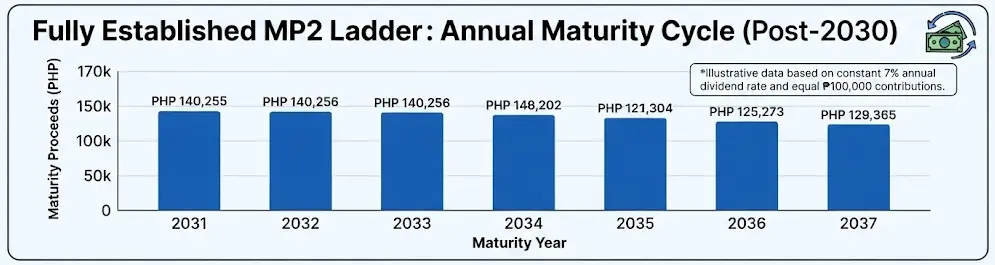
This is the central concept behind an MP2 ladderized strategy.
You are effectively creating a rolling five-year cycle.
Is MP2 Laddering Better Than a Lump Sum?
Not necessarily.
The two approaches serve different purposes.
A lump sum generally makes more sense when:
- You already have the entire amount available
- You do not need access to the money for five years
- You want the entire amount invested immediately
- Your priority is maximizing the time your money has to potentially earn dividends
A ladder may make more sense when:
- You want staggered maturity dates
- You expect future expenses at different times
- You want to avoid having all your savings mature in one year
- You want to create a recurring reinvestment cycle
- You value flexibility more than maximizing the investment period of the entire starting amount
The key takeaway is that laddering is primarily a cash-flow and maturity strategy, not a higher-return strategy.
If you have ₱500,000 today, investing the full amount immediately gives the entire ₱500,000 more time to potentially earn dividends than splitting it into five future deposits.
But if having access to ₱100,000 or more each year is more valuable to you than maximizing the growth of the entire starting balance, the ladder can be a useful structure.
Frequently Asked Questions About MP2 Laddering
Can I have multiple MP2 accounts?
Yes. The laddering strategy is based on having separate MP2 accounts opened at different times. Each account has its own five-year maturity period under the MP2 program.
Does MP2 laddering give a higher dividend rate?
No. Opening multiple accounts does not automatically give you a higher MP2 dividend rate.
The benefit comes from staggering the maturity dates and managing your cash flow.
Do I have to invest the same amount in every MP2 account?
No. Your ladder can use equal or different contribution amounts.
Can I receive MP2 dividends every year?
MP2 allows members to choose an annual dividend payout option or compounded dividend earnings.
However, annual dividend payout and laddering are different concepts. A ladder is about the timing of separate account maturities.
How long does an MP2 account run?
The MP2 membership term is five years from the date of the initial payment of savings.
Can I reinvest my MP2 maturity proceeds?
You can choose to use your maturity proceeds to fund another MP2 account, subject to the applicable rules and procedures at that time.
Is laddering better for retirement?
It can be useful as one component of a retirement savings strategy because staggered maturities may create a more predictable schedule of future cash availability.
However, MP2 should be considered alongside your emergency fund, other savings, investments, insurance, and retirement income sources.
Final Thoughts: Is the Pag-IBIG MP2 Ladder Strategy Worth It?
The Pag-IBIG MP2 laddering strategy is a simple idea with a potentially useful purpose.
Instead of putting all your savings into one MP2 account and waiting for a single maturity date, you spread your savings across multiple accounts opened at different times. After the initial setup period, this can create a cycle where an MP2 account matures every year.
The biggest advantage is not necessarily higher returns.
It is flexibility.
A ladder can help you organize long-term savings around future cash-flow needs. You can withdraw matured funds when needed, reinvest them into a new MP2 account, or combine both approaches.
At the same time, laddering comes with an important trade-off. If you already have a large amount of cash available today, delaying some of that money’s investment can reduce its potential earning period compared with investing the entire amount immediately.
That is why the choice between MP2 laddering vs. lump sum ultimately comes down to your goals.
If your priority is maximum time invested, a lump sum may be more efficient when you already have the full amount available.
If your priority is creating staggered maturity dates and a recurring stream of accessible savings, an MP2 ladder may be worth considering.
Before setting one up, calculate different scenarios using realistic assumptions, keep your emergency fund separate, and remember that MP2 dividend rates are not guaranteed.
The best ladder is ultimately one that matches your cash flow, financial goals, and need for future liquidity, rather than one based solely on chasing the highest projected dividend.