


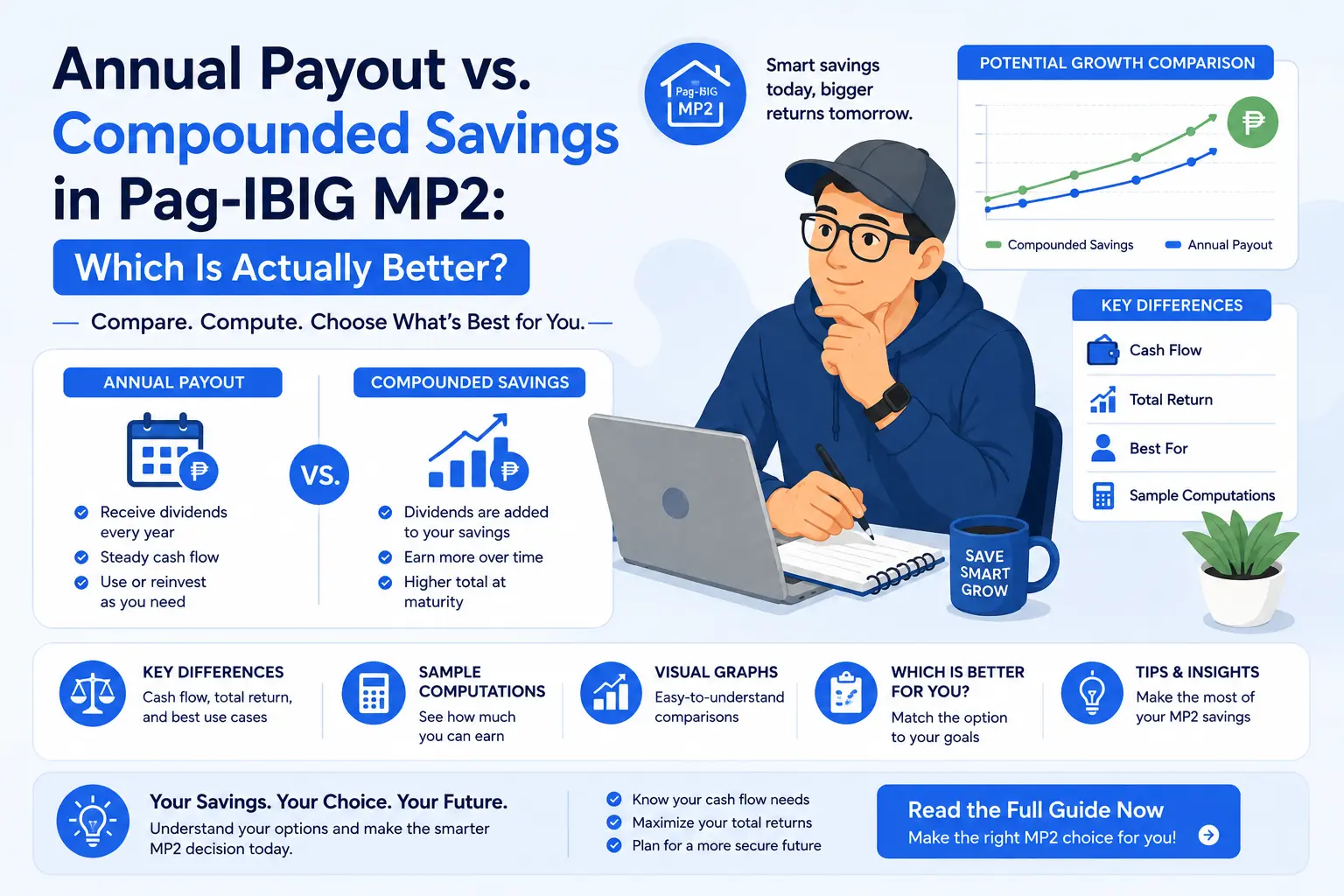
If you are saving through the Pag-IBIG Modified Pag-IBIG II (MP2) program, you have an important decision to make when opening your account: Do you want your dividends paid out annually, or do you want them compounded until your five-year maturity?
At first glance, annual payout can seem more attractive because you get access to your earnings every year. Compounding, meanwhile, sounds better for long-term growth because your dividends remain invested and can generate additional dividends.
So, which one actually gives you more money?
If your only goal is to maximize the amount you receive from the MP2 account at maturity, compounded dividends generally come out ahead, assuming the same dividend rates and that you do not need the annual income.
However, that does not automatically make compounding the better choice for everyone. Annual payout can be useful if you want to use your MP2 dividends as supplemental cash flow, reinvest them elsewhere, or use them towards yearly expenses.
This guide compares the two options using sample computations, explains how compounding affects your total return, and shows you how to determine which payout option applies to your own MP2 account.
Important: MP2 dividends are not fixed interest. Pag-IBIG Fund declares the MP2 dividend rate based on the Fund’s performance, so actual returns will vary from year to year. The calculations below use a constant 7% rate purely to illustrate the difference between annual payout and compounding.
Annual Payout vs. Compounded Dividends: What’s the Difference?
Pag-IBIG MP2 has a five-year maturity period. When you enrol, you can choose between annual dividend payout and compounded dividend earnings.
Under the annual payout option, your dividends are paid to you each year. Your original MP2 contributions remain in the account until maturity, subject to the programme’s rules.
Under the compounded option, your dividends remain with the MP2 account. The accumulated dividends become part of the amount that can earn dividends in subsequent years.
Pag-IBIG’s amended MP2 guidelines specifically state that members may choose between annual dividend payout and compounding at the point of application. The guidelines also distinguish what happens at maturity: members who choose compounding receive their total accumulated value, while members who choose annual payout receive their annual dividends separately and their contributions at the end of the five-year term.
Quick comparison
| Feature | Annual Dividend Payout | Compounded Dividends |
|---|---|---|
| Dividend received | Every year | At maturity |
| Principal/contributions | Released at maturity | Released at maturity with accumulated dividends |
| Dividends remain invested | No, once paid out | Yes |
| Benefits from compounding | No, within the MP2 account | Yes |
| Annual cash flow | Yes | No |
| Potential five-year total | Lower if payout is spent | Higher |
| Best suited for | Income and cash flow | Long-term growth |
The biggest distinction is simple:
Annual payout prioritizes access to your earnings. Compounding prioritizes growth.
What Does “Annual Payout” Actually Mean?
One common misunderstanding is that choosing annual payout means you can withdraw your entire MP2 savings every year.
That is not what it means.
Annual payout refers specifically to the dividends, not your entire principal.
For example, suppose you have ₱100,000 in MP2 and the declared dividend rate for the year is 7%.
Your illustrative dividend would be:
₱100,000 × 7% = ₱7,000
With annual payout, the ₱7,000 dividend is paid out according to the applicable Pag-IBIG process, while the ₱100,000 contribution remains subject to the five-year maturity period.
Pag-IBIG’s current annual dividend release form allows members to authorize the Fund to credit annual MP2 dividends to a personal bank account.
This makes annual payout particularly useful for someone who wants their MP2 savings to generate a regular yearly cash benefit.
What Happens With Compounded MP2 Dividends?
With compounding, the dividends stay invested instead of being paid out as annual cash.
Using the same ₱100,000 example and an illustrative constant 7% rate:
Year 1
₱100,000 × 7% = ₱7,000 dividend
New balance:
₱107,000
In Year 2, the 7% is applied to the larger amount:
₱107,000 × 7% = ₱7,490
New balance:
₱114,490
The additional ₱490 earned in Year 2 is the effect of earning dividends on the previous year’s dividends.
That is the basic idea behind compounding.
By Year 5, the difference becomes more noticeable.
Sample Computation: ₱100,000 Lump-Sum Savings
To make the comparison easy to understand, let’s assume:
- Initial MP2 savings: ₱100,000
- Annual dividend rate: 7%
- Holding period: 5 years
- Dividend rate remains 7% every year
- No additional contributions
- Annual payout dividends are actually paid out and not reinvested
Again, 7% is an illustrative rate, not a guaranteed MP2 rate.
Option 1: Annual Dividend Payout
Because the principal remains at ₱100,000 for this simplified example, the annual dividend is:
₱100,000 × 7% = ₱7,000
| Year | Principal | Dividend at 7% | Dividend Received |
|---|---|---|---|
| 1 | ₱100,000 | ₱7,000 | ₱7,000 |
| 2 | ₱100,000 | ₱7,000 | ₱7,000 |
| 3 | ₱100,000 | ₱7,000 | ₱7,000 |
| 4 | ₱100,000 | ₱7,000 | ₱7,000 |
| 5 | ₱100,000 | ₱7,000 | ₱7,000 |
| Total | ₱35,000 | ₱35,000 |
At maturity, you would receive your ₱100,000 principal, while the five years of dividends would have been paid out along the way.
Total value received over the five years:
₱100,000 + ₱35,000 = ₱135,000
Option 2: Compounded Dividends
Now suppose you choose compounding instead.
| Year | Starting Balance | 7% Dividend | Ending Balance |
|---|---|---|---|
| 1 | ₱100,000.00 | ₱7,000.00 | ₱107,000.00 |
| 2 | ₱107,000.00 | ₱7,490.00 | ₱114,490.00 |
| 3 | ₱114,490.00 | ₱8,014.30 | ₱122,504.30 |
| 4 | ₱122,504.30 | ₱8,575.30 | ₱131,079.60 |
| 5 | ₱131,079.60 | ₱9,175.57 | ₱140,255.17 |
After five years:
Total accumulated value = ₱140,255.17
Total dividends:
₱40,255.17
Compared with the annual payout scenario:
₱40,255.17 − ₱35,000 = ₱5,255.17
So, under these simplified assumptions, compounding gives you approximately ₱5,255 more over five years.
If you want to see how different starting amounts, monthly contributions, dividend rates, and investment periods can affect your potential MP2 savings, try our Pag-IBIG MP2 Calculator.
Visualising the Difference
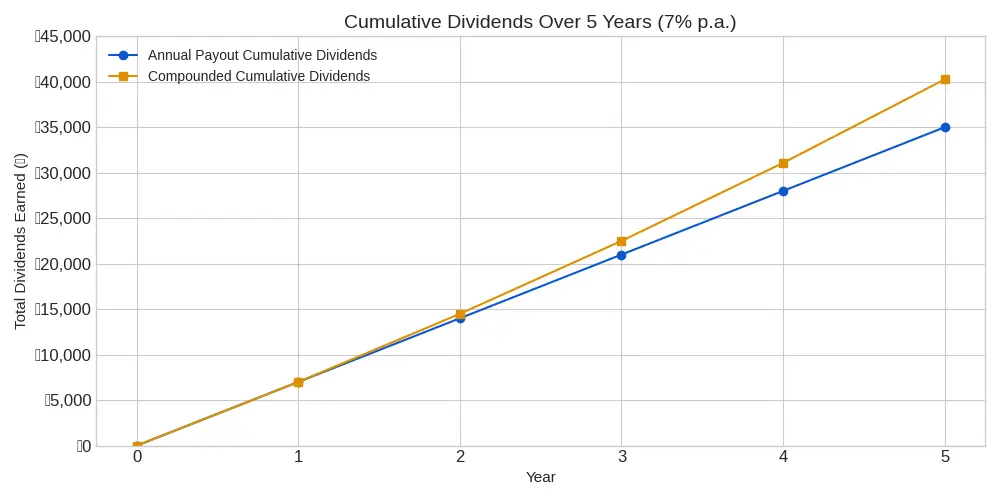
The difference becomes easier to understand when you look at the cumulative dividends.
The annual payout line grows at a steady rate because the same ₱100,000 principal is generating the illustrative 7% dividend each year.
The compounded balance grows faster because every year’s retained dividends increase the amount that can generate dividends in subsequent years.
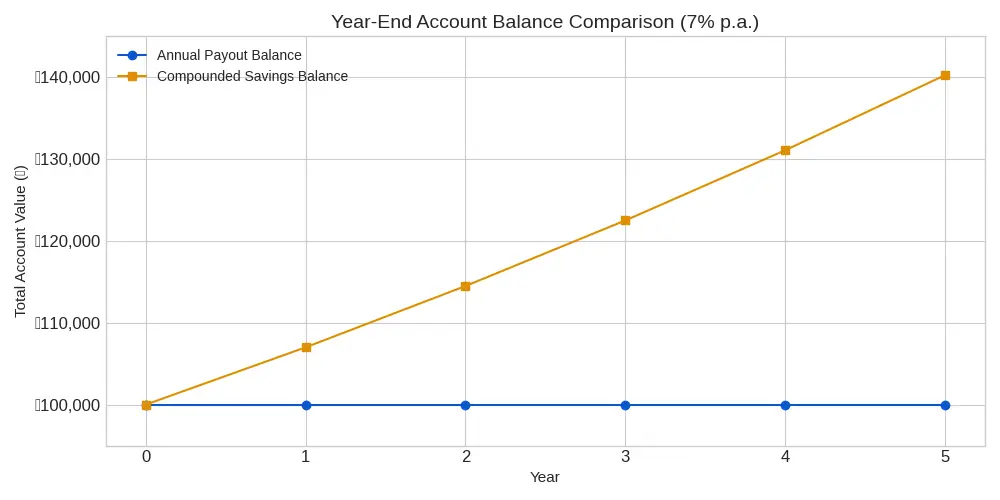
Year-end balance comparison
With annual payout, the MP2 principal in this example remains at ₱100,000 throughout the five-year period.
With compounding, the balance grows from ₱100,000 to approximately ₱140,255.17.
This is why the two options can produce different results even when they start with exactly the same amount and use the same dividend rate.
Why Does Compounding Produce a Higher Return?
The reason is straightforward: your dividends can themselves generate additional dividends.
Consider the difference between Years 1 and 5.
With annual payout:
- Year 1 dividend: ₱7,000
- Year 2 dividend: ₱7,000
- Year 3 dividend: ₱7,000
- Year 4 dividend: ₱7,000
- Year 5 dividend: ₱7,000
Your annual dividend remains the same in this simplified example because your principal does not change.
With compounding:
- Year 1 dividend: ₱7,000
- Year 2 dividend: ₱7,490
- Year 3 dividend: ₱8,014.30
- Year 4 dividend: ₱8,575.30
- Year 5 dividend: ₱9,175.57
The annual dividend gets progressively larger because the balance earning dividends gets larger.
This is the classic compounding effect.
But Is Compounding Always Better?
Not necessarily.
There are actually two different questions you should ask:
- Which option produces the larger MP2 balance?
- Which option is more useful for my financial goals?
If you only care about maximising the amount accumulated inside MP2 after five years, compounding has the advantage.
But if you need cash every year, annual payout may be more useful.
For example, imagine you have ₱500,000 in MP2 and the declared dividend rate is 7%.
A simplified annual dividend would be:
₱500,000 × 7% = ₱35,000
Receiving approximately ₱35,000 a year could be useful if you want to:
- supplement your income
- pay annual bills
- fund a holiday
- add money to another investment
- build your emergency fund
- reinvest into another financial product
- cover part of your yearly expenses
In this situation, the “lower” total MP2 return may be worth it because you are receiving cash when you actually need it.
Annual Payout vs. Compounding: Key Differences
1. Cash Flow
This is the biggest advantage of annual payout.
You receive dividends periodically instead of waiting until maturity for the accumulated dividends.
If your financial plan requires regular income, annual payout can be more practical.
Compounding works differently. You sacrifice access to those yearly dividends in exchange for greater potential growth within the MP2 account.
Winner for cash flow: Annual payout
2. Total Return
If you compare two identical MP2 accounts using the same dividend rates, and the annual dividends are not reinvested elsewhere, compounding will generally produce a higher final amount.
That is because the dividends themselves can generate additional dividends.
Winner for total MP2 growth: Compounding
3. Flexibility
Annual payout gives you more flexibility over what happens to your dividends once they are paid.
You could spend them, save them or invest them somewhere else.
With compounding, the money remains part of your MP2 savings until maturity.
Winner for immediate access to dividends: Annual payout
4. Long-Term Wealth Building
If you are using MP2 primarily as a long-term savings vehicle and do not need the income, compounding is generally the more growth-oriented option.
You are effectively allowing your money to work without taking the earnings out every year.
Winner for long-term accumulation: Compounding
When Should You Choose Annual Payout?
Annual payout may make sense if you:
- want additional yearly cash flow
- are already retired or approaching retirement
- want to use your dividends for recurring expenses
- want to reinvest the dividends into another investment
- prefer receiving returns periodically
- have a specific yearly financial goal for the dividends
For example, someone with ₱1 million in MP2 could potentially generate a meaningful annual dividend. Rather than waiting five years, they may prefer receiving the declared dividends each year.
The important thing is to have a plan for the money.
If you receive your annual dividend and simply spend it, you will not get the same compounding benefit as someone who leaves their dividends invested.
When Should You Choose Compounding?
Compounding may be more appropriate if you:
- do not need the dividends for day-to-day expenses
- are building wealth for a future goal
- want to maximize your MP2 maturity value
- are comfortable leaving the money untouched for five years
- prefer a simple “save now, collect later” strategy
This is particularly attractive if you are using MP2 as a medium-term savings bucket rather than an income source.
For example, you could use a five-year MP2 account for a future home down payment, business capital, education fund or another large financial goal.
A Crucial Point: Annual Payout Does Not Mean You Can Withdraw the Principal Every Year
This deserves emphasis because the terminology can be confusing.
Annual payout does not mean annual withdrawal of your entire MP2 balance.
The annual payout refers to your dividends.
Your contributions remain subject to the MP2 maturity rules.
The Supreme Court E-Library’s published copy of the amended MP2 guidelines states that members who choose annual dividend payout receive their annual dividends, while their contributions are released at the end of the five-year membership term.
If you want to understand the formal rules behind MP2, you can also review the amended MP2 guidelines issued under Pag-IBIG Fund Circular No. 407.
How Do You Determine Whether Annual Payout or Compounding Is Applied?
The most reliable way is to check what you selected when you enrolled in the MP2 account.
Pag-IBIG’s official Modified Pag-IBIG II Enrollment Form specifically includes the option to choose between:
- annual dividend payout
- compounded dividend earnings
The form also states that the membership term is five years from the date of the initial payment.
Check your MP2 enrollment records
Look for the payout option associated with the account.
If you selected annual dividend payout, your dividends are intended to be released annually.
If you selected compounded dividend earnings, the dividends remain accumulated with the MP2 savings until maturity.
Check your dividend credits
Your transaction history can also provide a useful clue.
If you have been receiving separate annual MP2 dividend credits in your nominated bank account, that is consistent with the annual payout option.
Pag-IBIG also provides an official application form for the release of MP2 annual dividends, which authorizes the crediting of annual dividends to a personal bank account.
Ask Pag-IBIG if you are still unsure
If you cannot find your original enrolLment information or your account history is unclear, contacting Pag-IBIG Fund is the safest way to confirm the payout option attached to your specific MP2 account.
Do not assume that simply leaving an annual dividend untouched automatically changes your account to the compounding option.
The important distinction is that annual payout and compounding are payout choices made for the MP2 account. The official guidelines treat them as separate options.
What If You Want to Reinvest Your Annual Dividend?
There is an important middle ground.
Choosing annual payout does not mean you have to spend the dividends.
Suppose your MP2 account pays you ₱10,000 in dividends this year.
You could:
- receive the ₱10,000
- keep it in a separate savings account
- invest or save it elsewhere
- potentially put it into another MP2 account when appropriate
However, this is not exactly the same as having that ₱10,000 automatically compound inside your original MP2 account.
If the dividend leaves the MP2 account, it is no longer generating MP2 dividends as part of that original account.
This distinction is important when comparing the two options.
What About Monthly MP2 Contributions?
The comparison becomes more complicated when you make regular monthly contributions.
For example, imagine saving ₱5,000 every month.
Your Year 1 contributions would total:
₱5,000 × 12 = ₱60,000
But the entire ₱60,000 does not necessarily sit in MP2 for the entire year.
A January contribution has a longer earning period than a December contribution.
This means you should be careful with simple calculations that multiply your total annual contribution by the dividend rate and assume every peso earned dividends for a full year.
Pag-IBIG’s own educational materials provide examples showing how regular monthly MP2 savings accumulate under the compounding option. One Pag-IBIG-related example uses a ₱1,000 monthly contribution and demonstrates the progressive increase in accumulated dividends over five years.
For a personalised estimate based on your starting amount, monthly contribution, expected dividend rate and investment period, you can use the Pag-IBIG MP2 Calculator.
Sample Scenario: ₱5,000 Monthly Contribution
Let’s use another simplified example.
Assume:
- Monthly contribution: ₱5,000
- Annual contribution: ₱60,000
- Five-year contributions: ₱300,000
- Illustrative dividend rate: 7%
- Contributions are made regularly
- Actual Pag-IBIG dividend rates will vary
At the end of five years, your total contributions would be:
₱5,000 × 60 months = ₱300,000
The actual dividend calculation will depend on how and when the contributions are credited and the dividend rates declared for each year.
This is why a calculator using assumptions about contribution timing can be more useful than simply multiplying ₱300,000 by 7%.
More importantly, the choice between payout and compounding still affects what happens to the dividends that are earned.
With annual payout:
You receive the dividends as cash.
With compounding:
The dividends remain accumulated and contribute to the amount available at maturity.
Does MP2 Have a Fixed Interest Rate?
No.
This is one of the most important things to remember when doing MP2 calculations.
MP2 pays dividends, rather than a guaranteed fixed interest rate.
The amended guidelines state that MP2 is entitled to flexible dividend rates, which are declared after Pag-IBIG Fund’s net income is computed and approved by its Board of Trustees.
Therefore, you should not assume that a 7% rate will apply for all five years.
A more realistic projection might use several scenarios:
| Scenario | Assumed Average Rate | Purpose |
|---|---|---|
| Conservative | 5% | Lower-return planning |
| Moderate | 6% | Middle estimate |
| Illustrative | 7% | Example only |
| Higher | 8% | Optimistic scenario |
These are planning assumptions, not guaranteed MP2 rates.
When deciding whether to use annual payout or compounding, it is better to test several rates rather than relying on one optimistic figure.
Which Is Actually Better?
The answer depends on what “better” means to you.
Choose annual payout if your priority is cash flow.
You receive your dividends periodically and can decide what to do with the money.
This can be particularly useful if you want your savings to generate an income stream rather than simply accumulate.
Choose compounding if your priority is maximum growth.
If you don’t need the dividends now, allowing them to remain invested can produce a higher accumulated value because future dividends can be earned on previously accumulated dividends.
Choose annual payout if you have a better use for the dividends.
There is another important consideration.
Suppose your MP2 generates a dividend and you can invest that money elsewhere at a potentially attractive return.
The relevant comparison is no longer simply:
Annual payout vs. compounding
It becomes:
MP2 compounding vs. annual MP2 dividends + your alternative investment return
If you are disciplined about reinvesting your annual dividends, the gap between the two strategies can potentially be reduced.
But that requires you to actually reinvest the money. If the annual dividend is spent, it cannot continue generating investment returns.
What Happens After the Five-Year Maturity?
MP2 has a five-year membership term.
Under the guidelines, a compounded account’s total accumulated value consists of the contributions and corresponding dividends. For an annual payout account, the annual dividends have already been paid separately, while the contributions are released at maturity.
If you want to continue saving through MP2 after maturity, you generally need to open a new MP2 account rather than simply assuming the existing account automatically becomes a new five-year MP2 account.
This is important when building a long-term MP2 strategy.
For example, someone could structure their savings around multiple MP2 accounts with different maturity dates instead of putting all their money into one account.
How to Decide: A Simple Framework
Ask yourself these five questions:
1. Do I need the dividends every year?
If yes, annual payout may be appropriate.
If no, continue to the next question.
2. Is my main goal maximum growth?
If yes, compounding is generally the more straightforward choice.
3. Do I have another investment where I can put the dividends?
If you have a clear reinvestment strategy, annual payout can still make sense.
4. Will I actually reinvest the dividends?
This is critical.
A strategy that looks good on paper only works if you follow it.
5. Can I leave the money alone for five years?
If yes, compounding may fit your objective.
If you need predictable access to yearly earnings, annual payout may be more suitable.
Annual Payout vs. Compounding: The Bottom Line
There is no universally “best” MP2 payout option.
Annual payout is better for cash flow.
Compounding is better for maximising the amount accumulated inside MP2.
Using our simplified ₱100,000 example at a constant 7% dividend rate:
| Annual Payout | Compounded | |
|---|---|---|
| Initial savings | ₱100,000 | ₱100,000 |
| Illustrative rate | 7% | 7% |
| Five-year dividends | ₱35,000 | ₱40,255.17 |
| Principal at maturity | ₱100,000 | Included in final value |
| Total value received | ₱135,000 | ₱140,255.17 |
| Difference | ₱5,255.17 more |
The compounding option wins in this simplified comparison because the dividends stay invested.
But that extra return comes with a trade-off: you give up the annual cash flow.
If you are saving for a future financial goal and don’t need the dividends, compounding is usually the more logical choice.
If you want MP2 to provide yearly income, annual payout can be more useful.
Ultimately, the best choice is the one that matches what you want your money to do over the next five years.
Frequently Asked Questions
Is annual payout better than compounding in MP2?
Not necessarily. Annual payout gives you access to your dividends each year, while compounding allows dividends to remain invested and potentially generate additional dividends. If your priority is maximum accumulation, compounding generally has the advantage.
Can I withdraw my entire MP2 savings every year with annual payout?
No. Annual payout refers to the dividends, not the entire principal. Your MP2 contributions remain subject to the program’s five-year maturity period.
Does MP2 compounding give a guaranteed return?
No. MP2 dividend rates are declared by Pag-IBIG Fund and can vary from year to year. Calculations using a fixed rate should therefore be treated as estimates rather than guarantees.
What happens if I choose annual payout?
Your annual MP2 dividends are released according to the applicable Pag-IBIG process, while your contributions remain invested until maturity, subject to the program’s rules. Pag-IBIG provides an official form for the release of annual MP2 dividends to a personal bank account.
Can I change from annual payout to compounding later?
Do not assume that you can simply switch the option whenever you want. The MP2 guidelines state that the choice between annual dividend payout and compounding is made at the point of application. If you want to change an existing account’s payout arrangement, confirm the applicable process directly with Pag-IBIG Fund.
How can I check my MP2 payout option?
Start by checking your original MP2 enrolLment records and account information. You can also review your transaction history for annual dividend credits. If you still cannot confirm the option, contact Pag-IBIG Fund.
Is the MP2 principal available after five years?
Yes, the MP2 program has a five-year maturity period, after which the savings are released according to the applicable maturity and claiming rules.
Can I open another MP2 account after maturity?
Yes. If you want to continue using MP2 after an account matures, you can plan for a new MP2 account rather than assuming the old account will continue indefinitely under the same MP2 terms.
Related MP2 Guides
If you are still setting up your MP2 strategy, these guides can help:
- Learn how to open a Pag-IBIG MP2 savings account and get started with your account.
- Find out how to withdraw your Pag-IBIG MP2 savings when your account reaches maturity.
- If you prefer digital payments, learn how to pay Pag-IBIG MP2 using GCash.
- Estimate your potential returns using the Pag-IBIG MP2 Calculator.
The key takeaway is simple: if you want the money now, annual payout gives you cash flow. If you want the biggest possible MP2 balance at maturity and can leave the dividends invested, compounding is generally the stronger option.