


For many Filipino employees, the 13th month pay is one of the most anticipated payments of the year. But while it is commonly associated with Christmas, figuring out exactly how much you should receive can be confusing, especially if you started your job midway through the year, received a salary increase, took unpaid absences, went on maternity leave, or resigned before December.
The good news is that the basic 13th month pay computation is relatively straightforward once you know what counts as basic salary.
For 2026, the general rule remains:
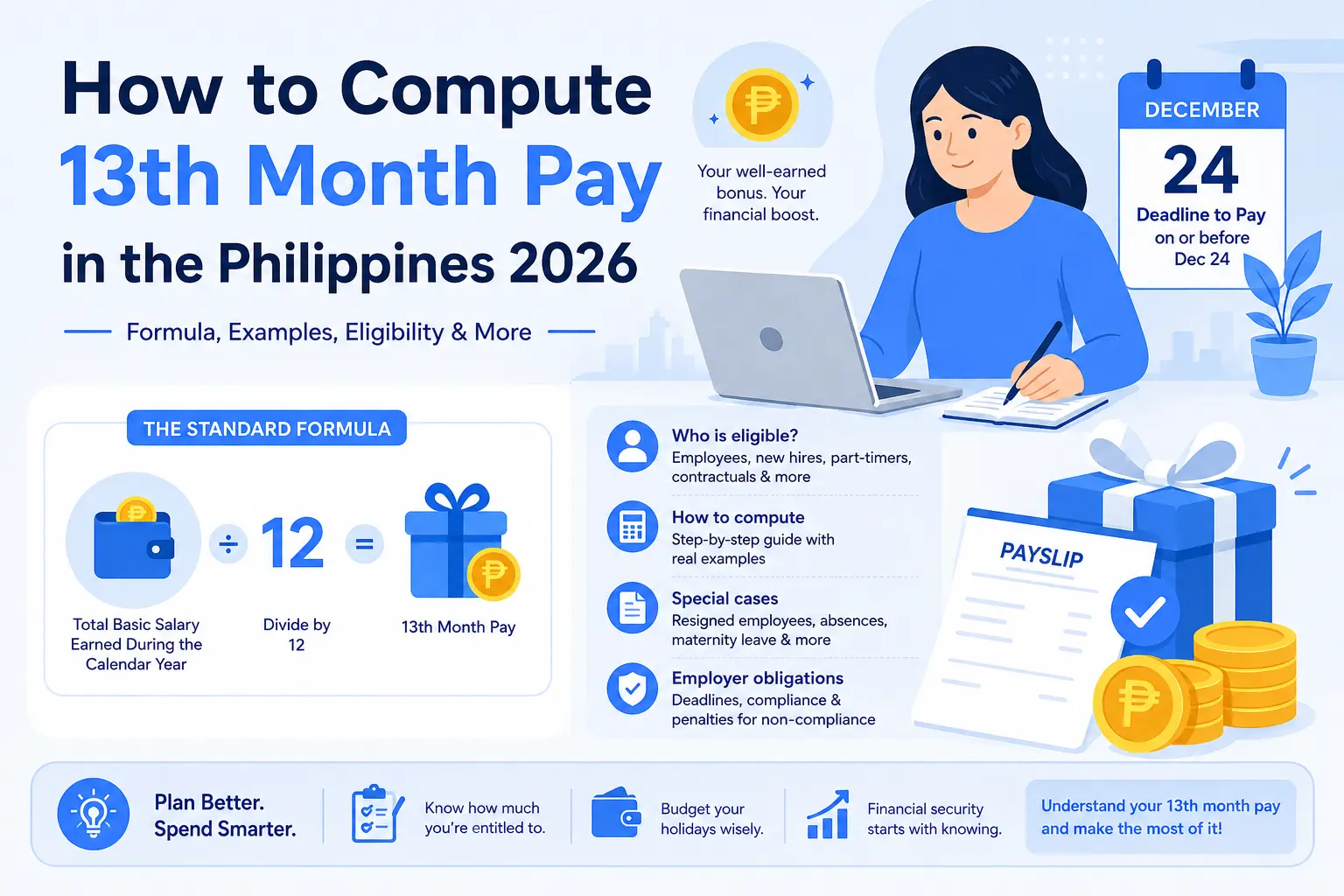
13th Month Pay = Total Basic Salary Earned During the Calendar Year ÷ 12
The Department of Labor and Employment (DOLE) reiterated this rule in Labor Advisory No. 16, Series of 2025, which remains the latest specific DOLE guideline on the payment of 13th month pay going into 2026. It covers rank-and-file employees in the private sector who have worked for at least one month during the calendar year.
This guide explains the 13th month pay computation in the Philippines, including who is entitled to it, what salary components are included, how to calculate prorated 13th month pay, what happens when an employee resigns, and whether the benefit is taxable.
What Is 13th Month Pay?
The 13th month pay is a mandatory monetary benefit for qualified rank-and-file employees in the private sector in the Philippines.
Under Presidential Decree No. 851, covered employers are required to provide their rank-and-file employees with a 13th month benefit equivalent to at least one-twelfth (1/12) of their total basic salary earned during the calendar year.
The important point is that the calculation is based on basic salary actually earned during the year, rather than simply taking your latest monthly salary and dividing or multiplying it.
For example, if you earned ₱30,000 in basic salary every month from January to December:
₱30,000 × 12 = ₱360,000 total basic salary
Then:
₱360,000 ÷ 12 = ₱30,000 13th month pay
However, if you started working in July, had unpaid absences, received a salary increase, or left the company before December, your computation will be different.
13th Month Pay vs Christmas Bonus: What’s the Difference?
The terms 13th month pay and Christmas bonus are sometimes used interchangeably, but they are not the same thing.
The 13th month pay is a statutory benefit required by law for covered employees. A Christmas bonus, on the other hand, is generally an additional benefit voluntarily provided by an employer.
| 13th Month Pay | Christmas Bonus |
|---|---|
| Required by law for covered employees | Generally voluntary |
| Based on basic salary earned | Amount is determined by the employer |
| Must meet the legal minimum | May be any amount |
| Generally paid by December 24 | Timing depends on the employer |
| Employees may have a legal claim to it | Usually no legal entitlement unless required by policy, contract, CBA, or established company practice |
An employer may call a payment a “Christmas bonus”, but its treatment can depend on what the payment actually represents and the company’s policies or agreements.
So, if your employer gives you a Christmas bonus in addition to your 13th month pay, that bonus is separate from the mandatory benefit.
The Standard 13th Month Pay Formula
The standard 13th month pay formula is:
Total Basic Salary Earned During the Calendar Year ÷ 12 = 13th Month Pay
For example:
- January to December basic salary: ₱35,000 per month
- Total basic salary: ₱420,000
- ₱420,000 ÷ 12 = ₱35,000
Your minimum thirteenth month pay would therefore be ₱35,000.
The calculation becomes more important when your salary or working period changes during the year.
What Is Included in Basic Salary?
For purposes of the computation of 13th month pay, basic salary generally includes remuneration or earnings paid by the employer for services rendered.
Depending on the company’s compensation structure, this can include:
- Regular basic salary
- Salary increases that form part of basic salary
- Basic wages earned during the year
- Certain salary-related payments if they have been integrated into basic salary through company policy, an individual agreement, or collective bargaining agreement
- Cost-of-living allowance (COLA) if it has been integrated into basic salary
DOLE explains that salary-related benefits normally excluded from basic salary may become part of the computation if an individual or collective agreement, company practice, or company policy treats them as part of basic salary.
What Is Excluded From the Computation?
Not every payment appearing on your payslip is automatically part of your thirteenth month pay.
Generally, the following are excluded when they are not considered part of basic salary:
- Overtime pay
- Premium pay
- Night shift differential
- Holiday pay
- Cash equivalent of unused vacation or sick leave credits
- Cost-of-living allowance (COLA), unless integrated into basic salary
- Profit-sharing payments
- Other allowances and monetary benefits that are not part of regular or basic salary
DOLE specifically lists these exclusions in its guidance on the 13th month benefit.
This is why simply adding up your entire gross income for the year may result in an incorrect 13th month computation.
Who Is Entitled to 13th Month Pay in the Philippines?
The general rule for 2026 is that a rank-and-file employee in the private sector is entitled to 13th month pay if they have rendered at least one month of service during the calendar year.
Importantly, entitlement is not limited to regular employees.
DOLE’s current guidance states that rank-and-file employees are covered regardless of their employment status or the method by which they are paid, provided they have worked for at least one month during the calendar year.
Are Contractual Employees Entitled to 13th Month Pay?
Yes, a contractual employee may be entitled to 13th month pay if they are a covered rank-and-file employee.
Being called “contractual”, “project-based”, or “fixed-term” does not automatically remove the entitlement. The important consideration is whether the employee falls within the covered category and has worked for at least one month during the calendar year.
DOLE has consistently stated that entitlement applies regardless of employment status.
Are Part-Time Employees Entitled to 13th Month Pay?
Yes. A part-time rank-and-file employee can be entitled to thirteenth month pay.
The benefit is based on the employee’s actual basic salary earned during the calendar year, so a part-time worker will generally receive a proportionate amount based on what they actually earned.
For example, if a part-time employee earned ₱120,000 in basic salary during the year:
₱120,000 ÷ 12 = ₱10,000
Their minimum 13th month pay would be ₱10,000.
What About New Employees?
New employees can also qualify.
You do not have to work for the company for the entire year. The minimum requirement is generally that you have worked for at least one month during the calendar year.
For example, if you joined a company in July and earned ₱30,000 in basic salary every month from July through December:
₱30,000 × 6 = ₱180,000
₱180,000 ÷ 12 = ₱15,000
Your prorated 13th month pay would be ₱15,000.
This is one reason why the 13th month pay computation for 6 months is simply based on the total basic salary you actually earned during those six months, rather than automatically receiving half of your current monthly salary.
How to Compute 13th Month Pay: Examples
Here are some practical examples of 13th month pay computation in the Philippines.
| Scenario | Computation | 13th Month Pay |
|---|---|---|
| A. Complete year, ₱30,000/month | ₱30,000 × 12 ÷ 12 | ₱30,000 |
| B. Started in July, ₱30,000/month | ₱30,000 × 6 ÷ 12 | ₱15,000 |
| C. ₱30,000/month with ₱5,000 total unpaid absences | (₱360,000 − ₱5,000) ÷ 12 | ₱29,583.33 |
| D. Salary increased from ₱30,000 to ₱35,000 | (₱30,000 × 6 + ₱35,000 × 6) ÷ 12 | ₱32,500 |
| E. Resigned after September, ₱30,000/month | ₱30,000 × 9 ÷ 12 | ₱22,500 |
Example A: Complete Basic Salary Earned in a Year
Suppose Maria earns a basic salary of ₱40,000 per month and worked throughout January to December.
Her total basic salary is:
₱40,000 × 12 = ₱480,000
Her thirteenth month pay is:
₱480,000 ÷ 12 = ₱40,000
Maria receives ₱40,000 in 13th month pay.
Example B: Incomplete Basic Salary Due to Absences
Suppose Juan earns ₱30,000 per month.
His normal annual basic salary would be ₱360,000. However, he had several unpaid absences during the year that reduced his basic salary by a total of ₱5,000.
His actual basic salary earned becomes:
₱360,000 − ₱5,000 = ₱355,000
Therefore:
₱355,000 ÷ 12 = ₱29,583.33
Juan’s 13th month pay would be ₱29,583.33, assuming the ₱5,000 represented unpaid time that reduced his basic salary.
This illustrates why you should use your actual basic salary earned, rather than simply multiplying your current monthly salary by 12.
Example C: Employee Who Started Mid-Year
Suppose Ana joined the company on July 1 and earns ₱35,000 per month.
She earned six months of basic salary:
₱35,000 × 6 = ₱210,000
Her prorated 13th month pay is:
₱210,000 ÷ 12 = ₱17,500
Example D: Employee Who Received a Salary Increase
Suppose Carlo earned ₱30,000 per month from January to June, then received a salary increase to ₱35,000 from July to December.
His annual basic salary is:
₱30,000 × 6 = ₱180,000
plus:
₱35,000 × 6 = ₱210,000
Total:
₱390,000
Therefore:
₱390,000 ÷ 12 = ₱32,500
Carlo’s 13th month pay is ₱32,500.
This is an important example because your 13th month pay is not necessarily equal to your current monthly salary.
A Simpler Way to Calculate Your 13th Month Pay
If you already know your total basic salary for the year, the calculation only takes a few seconds. Simply divide your total basic salary by 12. If you want to check your calculation or compare different scenarios, you can also use our 13th month pay calculator.
When Is 13th Month Pay Given in the Philippines?
For covered private-sector employees, the thirteenth month pay must be paid on or before December 24.
The latest DOLE-BWC guidance reiterates that employers must release the benefit no later than December 24.
Employers may also release the benefit earlier. There is no requirement that employees wait until December 24.
In some circumstances, employers may provide the benefit in instalments, provided the required amount is paid within the prescribed period.
For 2026, employees should therefore expect their mandatory 13th month pay to be fully released not later than December 24, 2026, subject to the applicable rules and any updated DOLE issuance.
For the latest official reminder, see the DOLE-BWC reminder on releasing 13th-month pay not later than December 24.
Are There Employers Who Are Exempted From Providing 13th Month Pay?
There are specific exclusions under P.D. 851.
Historically, these include:
- The government and its political subdivisions, including certain government-owned and controlled corporations, subject to the exceptions provided by law.
- Employers already paying a 13th month benefit or its equivalent amounting to at least the required benefit under the applicable rules.
- Certain employers of persons in personal service.
- Certain workers paid purely on a commission, boundary, or task basis, or a fixed amount for performing a specific work, subject to the rules and exceptions applicable to their payment arrangement.
The DOLE/NWPC handbook also explains the historical coverage and exclusions under P.D. 851.
However, these exemptions should not be interpreted too broadly.
For example, DOLE’s current guidance expressly recognises entitlement for covered piece-rate employees and employees receiving fixed or guaranteed wages plus commissions.
Domestic workers also require separate consideration because the Kasambahay Law subsequently extended statutory protections to them.
If you are unsure whether your employment arrangement is covered, it is better to check the current DOLE rules rather than assuming that being “contractual”, “commission-based”, or “part-time” automatically means you are excluded.
For the underlying law, you can refer to P.D. 851: 13th Month Pay.
Are Maternity Leave Benefits Included in the Computation of 13th Month Pay?
Maternity leave can create confusion because not every payment received while an employee is on leave is automatically treated as basic salary.
Under the latest DOLE guidance, rank-and-file employees who were on maternity leave and received a salary differential are among those entitled to 13th month pay.
The key consideration is the amount that qualifies as basic salary for the purpose of the computation.
If an employee receives a salary differential that forms part of the relevant basic salary under the applicable rules, that amount is considered in determining the 13th month benefit.
In practice, employees on maternity leave should review their payroll records and the way the employer treated the salary differential rather than simply assuming that the entire maternity benefit is included.
Is the 13th Month Pay Taxable?
The 13th month pay is not automatically fully taxable.
Under current Philippine tax rules, the combined amount of qualified 13th month pay and other benefits is generally tax-exempt up to ₱90,000.
If the total exceeds ₱90,000, the excess is generally included in taxable compensation.
For example:
13th month pay: ₱80,000
Other qualified benefits: ₱10,000
Total: ₱90,000
The amount within the ₱90,000 threshold is not subject to income tax.
If the combined qualified amount is ₱120,000:
₱120,000 − ₱90,000 = ₱30,000 taxable excess
The Bureau of Internal Revenue’s withholding tax calculator specifically identifies the ₱90,000 ceiling and automatically treats the excess of non-taxable 13th month pay and other benefits as taxable compensation.
Remember that the ₱90,000 threshold applies to the relevant combined 13th month pay and other benefits, not simply the 13th month pay by itself.
Are Resigned, Separated, or Terminated Employees Still Entitled to 13th Month Pay?
Yes.
Resigning before December does not automatically mean you lose your thirteenth month pay.
DOLE specifically recognises rank-and-file employees who have resigned or been terminated as entitled to their proportionate 13th month pay.
The same applies whether you leave voluntarily or your employment is terminated, provided you are otherwise a covered employee.
The amount is calculated using the basic salary you actually earned from the beginning of the calendar year up to your last day of employment.
How to Compute 13th Month Pay for a Resigned, Separated, or Terminated Employee
The formula remains the same:
Total basic salary earned before separation ÷ 12 = Pro-rated 13th month pay
For example, suppose an employee earns ₱45,000 per month and resigns at the end of August.
Total basic salary earned:
₱45,000 × 8 = ₱360,000
Pro-rated 13th month pay:
₱360,000 ÷ 12 = ₱30,000
The employee is therefore entitled to ₱30,000 in proportionate 13th month pay.
If the employee’s salary changed during the year, use the actual basic salary earned during each period rather than simply multiplying the latest salary by the number of months worked.
The proportionate 13th month pay should form part of the employee’s final pay. DOLE’s 2026 guidance on final pay also specifically identifies pro-rated 13th month pay as one of the amounts that may be included in an employee’s final pay.
What About Employees With Multiple Employers?
Employees who work for more than one private employer may be entitled to 13th month pay from each covered employer.
The computation is based on the basic salary earned from each employer.
For example:
- Employer A basic salary earned: ₱240,000
- Employer B basic salary earned: ₱120,000
Employer A:
₱240,000 ÷ 12 = ₱20,000
Employer B:
₱120,000 ÷ 12 = ₱10,000
Total 13th month pay received:
₱30,000
DOLE’s guidance recognises employees with multiple employers as covered workers when the requirements are met.
Employer Obligations for 13th Month Pay in the Philippines
Employers have several important obligations when providing the 13th month benefit.
1. Pay the required amount
The benefit must be at least:
Total basic salary earned ÷ 12
Employers may voluntarily provide more than the statutory minimum.
2. Pay it on time
The 13th month pay must be released no later than December 24 for covered employees.
3. Correctly identify basic salary
Employers should not simply use gross compensation if the employee’s gross pay contains allowances, overtime, bonuses, or other amounts that are excluded from basic salary.
4. Include eligible separated employees
Employees who resign or are terminated before the normal payment date remain entitled to their proportionate benefit.
5. Submit compliance reports
DOLE’s guidelines require covered establishments to submit the appropriate compliance report through the DOLE Online Compliance Portal within the prescribed deadline. For the 2025 payment cycle, the deadline was January 15, 2026.
Employers should check the latest DOLE issuance for the applicable reporting deadline for each payment year.
Potential Penalties for Non-Compliance
Failure to pay the required 13th month pay can result in a worker pursuing a money claim for the unpaid or underpaid benefit.
DOLE has stated that employers who fail to provide the required 13th month benefit may face money claims filed with the appropriate DOLE regional office.
The issue is not limited to whether an employer eventually intends to pay. The benefit is a statutory labour standard, and DOLE has emphasised that employers cannot simply request to defer the payment. The 2025 advisory specifically states that requests for exemption or deferment of the 13th month payment will not be allowed under the advisory.
Depending on the nature and amount of the claim, a dispute may be handled through DOLE’s mechanisms for money claims or through the appropriate labour tribunal.
Employers should therefore keep accurate payroll records, properly identify covered employees, calculate basic salary correctly, and release the benefit within the required period.
Frequently Asked Questions About 13th Month Pay
How much is the 13th month pay?
It depends on your total basic salary earned during the calendar year.
The standard formula is:
Total basic salary earned ÷ 12
If you earned ₱360,000 in basic salary during the year, your 13th month pay is ₱30,000.
Is 13th month pay always equal to one month’s salary?
No.
It may be equal to one month’s salary if you worked the entire year and your monthly basic salary remained the same.
If you started mid-year, resigned, took unpaid absences, or had salary changes, your 13th month pay may be higher or lower than your current monthly salary.
How do I compute 13th month pay for six months?
Add the total basic salary you earned during those six months and divide it by 12.
For example:
₱30,000 × 6 ÷ 12 = ₱15,000
Do absences affect 13th month pay?
Unpaid absences can reduce your 13th month pay because the formula is based on the basic salary actually earned during the year.
Paid absences are treated differently because the employee continues receiving the relevant salary.
Are contractual workers entitled to 13th month pay?
A contractual worker who is a covered rank-and-file employee can be entitled to 13th month pay. Employment status alone does not remove the entitlement.
Are part-time workers entitled to 13th month pay?
Yes, if they are covered rank-and-file employees and have worked for at least one month during the calendar year. Their benefit is based on the basic salary they actually earned.
Do resigned employees lose their 13th month pay?
No. Covered employees who resign are entitled to their proportionate 13th month pay based on their basic salary earned before separation.
Is 13th month pay taxable?
It can be.
The combined 13th month pay and qualified other benefits are generally tax-exempt up to ₱90,000. The excess is generally taxable.
Final Takeaway
Understanding how to compute 13th month pay in the Philippines comes down to one key number: your total basic salary actually earned during the calendar year.
The standard formula is:
13th Month Pay = Total Basic Salary Earned During the Year ÷ 12
For a full-year employee with a consistent salary, the answer is usually straightforward. But if you started during the year, received a salary increase, had unpaid absences, worked part-time, went on maternity leave, or resigned before December, you need to calculate the total basic salary you actually earned before applying the formula.
For 2026, covered private-sector rank-and-file employees who have worked for at least one month during the calendar year remain entitled to the benefit, while employers are required to release it no later than December 24.
If you want a quick estimate without doing the maths manually, you can use the 13th month pay calculator and enter your salary information to calculate your expected benefit.
For the legal basis and official guidance, employees and employers can also refer to P.D. 851: 13th Month Pay and the latest issuances from DOLE’s Bureau of Working Conditions.