


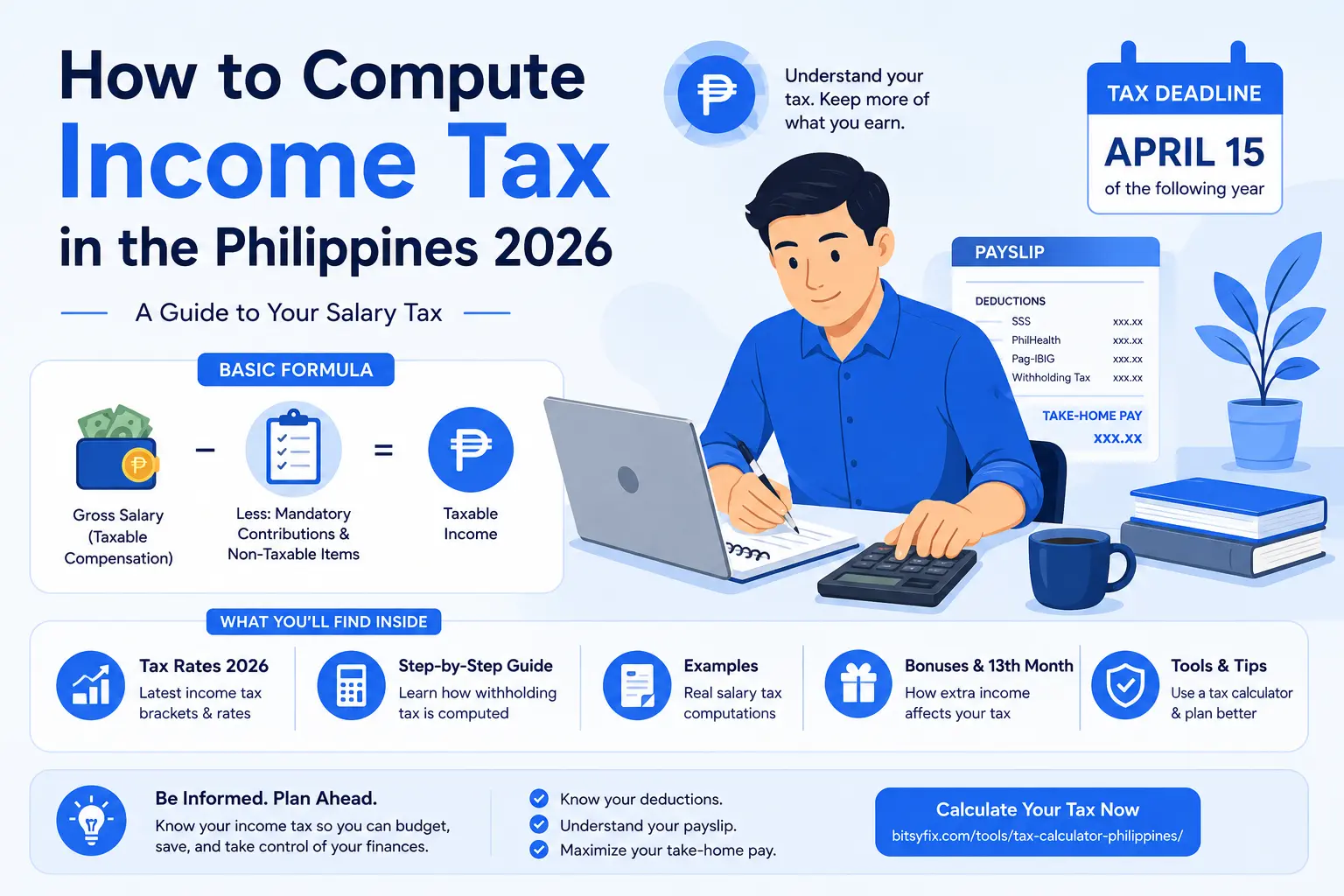
If you are a salaried employee in the Philippines, your gross salary is probably not the same as the amount that reaches your bank account each payday. Your payslip may include deductions for SSS, PhilHealth, Pag-IBIG, withholding tax, and other authorised deductions.
One of the biggest deductions to understand is income tax.
Knowing how income tax works can help you understand your payslip, estimate your take-home pay, compare job offers, and check whether the amount of tax withheld from your salary makes sense.
For 2026, the current graduated income tax rates for individuals remain based on the tax schedule effective from January 1, 2023. Under the current rules, annual taxable income of up to ₱250,000 is subject to a 0% rate, while higher portions of taxable income are taxed at rates ranging from 15% to 35%.
There is also a proposed increase in the tax-free income threshold from ₱250,000 to ₱350,000, which could change the calculation for many Filipino workers. However, the proposed increase is not yet in effect, so the existing ₱250,000 threshold remains applicable for current 2026 calculations.
This guide explains how to compute income tax in the Philippines in 2026, including the current tax brackets, how SSS, PhilHealth and Pag-IBIG contributions affect taxable compensation, how monthly withholding tax works, and how much tax you might pay at different salary levels.
Important: The calculations in this article are illustrative estimates for employees earning purely compensation income. Actual withholding can vary depending on your payroll period, taxable allowances, bonuses, benefits, contribution amounts, salary changes, and year-end adjustments.
What Is Income Tax?
Income tax is a tax imposed on income earned by individuals and businesses.
For employees, the type of tax you will generally encounter on your payslip is income tax on compensation. This covers salary and other taxable compensation received because of your employment.
Rather than requiring employees to pay their entire annual income tax at the end of the year, employers generally deduct or withhold income tax from employees’ compensation and remit the amount to the Bureau of Internal Revenue (BIR).
This is known as withholding tax on compensation.
The BIR’s withholding tax calculator identifies regular compensation as including basic salary and certain allowances, less mandatory employee deductions such as SSS, PhilHealth and Pag-IBIG contributions. It also identifies supplementary compensation, which can include commissions, overtime pay, taxable bonuses and other taxable benefits.
For official information, you can refer to the BIR’s resources on income tax in the Philippines.
How Income Tax on Salary Works in the Philippines
The easiest way to understand salary tax is to think of your compensation in three stages:
Gross salary → Taxable compensation → Net salary
These amounts are not necessarily the same.
Your gross salary is what you earn before deductions. However, not all compensation is necessarily subject to income tax, and certain mandatory employee contributions can be taken into account when determining taxable compensation.
Your net salary, meanwhile, is the amount you actually receive after income tax and other applicable deductions.
For example, an employee earning ₱50,000 per month may have deductions for:
- SSS
- PhilHealth
- Pag-IBIG
- Withholding income tax
The amount left after these deductions is the employee’s approximate take-home pay.
The basic process
For an employee earning purely compensation income, the calculation generally involves:
- Determine your gross compensation.
- Identify taxable and non-taxable compensation.
- Account for applicable employee contributions.
- Determine your taxable compensation.
- Apply the appropriate income tax rate.
- Calculate the amount of tax to be withheld.
The BIR’s own withholding tax calculator follows this general structure by separating regular compensation, supplementary compensation, mandatory deductions and non-taxable compensation.
Philippine Income Tax Rates for 2026
For 2026, the current graduated individual income tax rates remain as follows:
| Annual Taxable Income | Income Tax Due |
|---|---|
| Not over ₱250,000 | 0% |
| Over ₱250,000 to ₱400,000 | 15% of excess over ₱250,000 |
| Over ₱400,000 to ₱800,000 | ₱22,500 + 20% of excess over ₱400,000 |
| Over ₱800,000 to ₱2,000,000 | ₱102,500 + 25% of excess over ₱800,000 |
| Over ₱2,000,000 to ₱8,000,000 | ₱402,500 + 30% of excess over ₱2,000,000 |
| Over ₱8,000,000 | ₱2,202,500 + 35% of excess over ₱8,000,000 |
These are the graduated rates effective from January 1, 2023 onwards. They remain the applicable rates for 2026 unless a new law changes them.
How the progressive tax brackets work
It is important to understand that moving into a higher tax bracket does not mean your entire salary is suddenly taxed at the higher rate.
For example, if your annual taxable income is ₱500,000, you do not simply multiply ₱500,000 by 20%.
Instead, the first ₱400,000 is accounted for under the lower brackets, and only the amount above ₱400,000 is subject to the 20% rate in that bracket.
The formula is:
₱22,500 + 20% of the excess over ₱400,000
This progressive structure is why your effective tax rate can be lower than the highest marginal tax rate that applies to your income bracket.
Proposed Increase in the Tax-Free Income Ceiling to ₱350,000
There is an important proposed tax change that Filipino employees should know about in 2026.
The current income tax system provides a 0% rate for annual taxable income up to ₱250,000. However, the House of Representatives has been pursuing legislation that would increase the annual tax-free income threshold to ₱350,000.
The proposal would increase the current threshold by ₱100,000 and could allow more workers to keep a larger portion of their income. House Bill No. 10345 was filed to increase the annual income tax exemption ceiling from ₱250,000 to ₱350,000.
You can read the House of Representatives’ announcement about the proposed change here:
House proposal to raise the annual tax exemption ceiling to ₱350,000
However, there is an important distinction between a proposed tax reform and a tax rule that is already in force.
As of August 2026, the ₱350,000 threshold is still being pushed through the legislative process. It has not replaced the existing ₱250,000 threshold.
That means you should continue using the current ₱250,000 threshold when calculating your 2026 income tax unless and until the proposed change becomes law and takes effect.
This is particularly important when using an income tax calculator tool. Applying the proposed ₱350,000 threshold prematurely could result in an inaccurate tax estimate.
How to Compute Taxable Income From Your Salary
Your income tax is generally based on taxable compensation, not simply your gross monthly salary.
A simplified calculation looks like this:
Gross compensation − applicable non-taxable amounts and employee contributions = taxable compensation
For employees, mandatory contributions such as SSS, PhilHealth and Pag-IBIG are important parts of this calculation.
The BIR’s withholding tax calculator specifically identifies mandatory deductions such as SSS, PhilHealth and Pag-IBIG when determining net taxable compensation.
However, not every deduction or benefit on your payslip should automatically be treated as non-taxable.
The tax treatment depends on the nature of the payment.
For example, some allowances may be taxable, while certain benefits may be exempt within prescribed limits.
What Salary Deductions Are Non-Taxable?
SSS
SSS contributions are among the mandatory employee contributions taken into account in determining taxable compensation for withholding tax purposes.
Beginning January 2025, the SSS contribution rate became 15% of the applicable Monthly Salary Credit (MSC), with 10% paid by the employer and 5% by the employee. The maximum MSC is ₱35,000.
This means the employee contribution is generally capped based on the applicable maximum MSC rather than being calculated as 5% of an employee’s entire salary.
For an employee whose compensation falls at or above the maximum MSC, the employee’s regular SSS contribution is generally:
₱35,000 × 5% = ₱1,750
PhilHealth
PhilHealth contributions are also considered in determining taxable compensation.
The current PhilHealth premium rate is 5%, with an income floor of ₱10,000 and an income ceiling of ₱100,000 under the current contribution schedule. The premium is generally shared equally between the employer and employee.
For example, an employee earning ₱50,000 in monthly basic salary would have a total PhilHealth premium of:
₱50,000 × 5% = ₱2,500
The employee’s share would generally be:
₱2,500 ÷ 2 = ₱1,250
Pag-IBIG
Pag-IBIG contributions are also recognised as mandatory employee deductions in the BIR’s withholding tax calculation.
For simplified examples in this article, we use an employee Pag-IBIG contribution of ₱200 per month for employees whose applicable fund salary reaches the current maximum fund salary used for mandatory savings.
Your actual Pag-IBIG deduction should be based on your payroll records and the applicable Pag-IBIG contribution rules.
Important: Not Every Deduction Is Non-Taxable
It is worth remembering that “deducted from my salary” and “deducted before calculating tax” are not necessarily the same thing.
Your payslip could include deductions for:
- SSS
- PhilHealth
- Pag-IBIG
- Income tax
- Salary loans
- Company loans
- Insurance
- Other authorised deductions
The treatment of each item can be different.
For purposes of estimating taxable compensation, use the deductions that are recognised under the applicable tax rules rather than simply subtracting every deduction appearing on your payslip.
Gross Salary vs Taxable Income vs Net Salary
These three terms are often confused, but they represent different amounts.
Gross Salary
Your gross salary is the amount you earn before deductions.
For example:
₱50,000 monthly gross salary
This is not necessarily the amount used directly to calculate income tax.
Taxable Income
Your taxable compensation is the amount that remains subject to income tax after applicable exclusions and recognised employee contributions.
In a simplified example:
₱50,000 gross salary
− ₱1,750 SSS
− ₱1,250 PhilHealth
− ₱200 Pag-IBIG
= ₱46,800 estimated monthly taxable compensation
Net Salary
Your net salary, or take-home pay, is what remains after applicable deductions.
This can include:
- Income tax
- SSS
- PhilHealth
- Pag-IBIG
- Other authorised deductions
So:
Gross salary ≠ taxable income ≠ net salary
Understanding this distinction makes it much easier to read your payslip and estimate your actual take-home pay.
How to Compute Monthly Withholding Tax
Employers generally withhold income tax from an employee’s compensation every payroll period.
The BIR provides separate withholding tax tables depending on whether employees are paid daily, weekly, semi-monthly or monthly.
For employees paid monthly, the current withholding tax table is:
| Monthly Taxable Compensation | Prescribed Withholding Tax |
|---|---|
| ₱20,833 and below | ₱0 |
| Over ₱20,833 to ₱33,332 | 15% of excess over ₱20,833 |
| Over ₱33,333 to ₱66,666 | ₱1,875 + 20% of excess over ₱33,333 |
| Over ₱66,667 to ₱166,666 | ₱8,541.80 + 25% of excess over ₱66,667 |
| Over ₱166,667 to ₱666,666 | ₱33,541.80 + 30% of excess over ₱166,667 |
| Over ₱666,667 | ₱183,541.80 + 35% of excess over ₱666,667 |
The BIR’s current withholding tax table is effective January 1, 2023 onwards.
Again, the tax table is applied to taxable compensation, not simply your gross salary.
The BIR’s withholding tax calculator also accounts for regular compensation, supplementary compensation and mandatory deductions.
Sample Income Tax Computations
The following examples illustrate how estimated annual income tax changes at different salary levels.
For consistency, the examples assume:
- The employee earns the same gross salary throughout the year.
- The employee earns purely compensation income.
- There are no additional taxable bonuses, commissions or allowances.
- SSS, PhilHealth and Pag-IBIG contributions are deducted.
- The employee’s applicable contributions remain consistent throughout the year.
- The annualised tax calculation is used to demonstrate the current graduated tax brackets.
The figures are illustrative, not an exact prediction of an employer’s monthly payroll withholding.
Sample Income Tax Computation Table
| Monthly Gross Salary | Annual Gross Salary | Est. Monthly Employee Contributions | Est. Annual Taxable Income | Applicable Tax Bracket | Est. Annual Income Tax |
|---|---|---|---|---|---|
| ₱20,000 | ₱240,000 | ₱2,450 | ₱210,600 | 0% | ₱0 |
| ₱30,000 | ₱360,000 | ₱2,450 | ₱330,600 | 15% | ₱12,090 |
| ₱50,000 | ₱600,000 | ₱3,200 | ₱561,600 | 20% | ₱54,820 |
| ₱75,000 | ₱900,000 | ₱3,825 | ₱854,100 | 25% | ₱116,025 |
| ₱100,000 | ₱1,200,000 | ₱4,450 | ₱1,146,600 | 25% | ₱189,150 |
Example: ₱20,000 Monthly Salary
An employee earning ₱20,000 per month has an annual gross salary of:
₱20,000 × 12 = ₱240,000
Using the simplified contribution assumptions in this article:
₱20,000 − ₱2,450 = ₱17,550 estimated monthly taxable compensation
Annual taxable compensation:
₱17,550 × 12 = ₱210,600
Because this is below the current ₱250,000 annual taxable income threshold, the estimated annual income tax is:
₱0
The employee may still have SSS, PhilHealth and Pag-IBIG deductions even though no income tax is due under these assumptions.
Example: ₱30,000 Monthly Salary
An employee earning ₱30,000 per month has:
₱30,000 × 12 = ₱360,000 annual gross salary
Using estimated employee contributions of:
- SSS: ₱1,500
- PhilHealth: ₱750
- Pag-IBIG: ₱200
Total monthly contributions:
₱2,450
Estimated monthly taxable compensation:
₱30,000 − ₱2,450 = ₱27,550
Annual taxable compensation:
₱27,550 × 12 = ₱330,600
This falls within the ₱250,000 to ₱400,000 annual taxable income bracket.
Taxable excess:
₱330,600 − ₱250,000 = ₱80,600
Estimated annual income tax:
₱80,600 × 15% = ₱12,090
Example: ₱50,000 Monthly Salary
An employee earning ₱50,000 per month has:
₱50,000 × 12 = ₱600,000 annual gross salary
Estimated employee contributions:
- SSS: ₱1,750
- PhilHealth: ₱1,250
- Pag-IBIG: ₱200
Total:
₱3,200 per month
Estimated taxable compensation:
₱50,000 − ₱3,200 = ₱46,800 per month
Annual taxable compensation:
₱46,800 × 12 = ₱561,600
This falls within the ₱400,000 to ₱800,000 bracket.
The tax is:
₱22,500 + 20% of the excess over ₱400,000
Excess:
₱561,600 − ₱400,000 = ₱161,600
Tax on excess:
₱161,600 × 20% = ₱32,320
Estimated annual income tax:
₱22,500 + ₱32,320 = ₱54,820
Estimated monthly equivalent:
₱54,820 ÷ 12 = ₱4,568.33
Example: ₱75,000 Monthly Salary
An employee earning ₱75,000 per month has:
₱75,000 × 12 = ₱900,000 annual gross salary
Estimated employee contributions:
- SSS: ₱1,750
- PhilHealth: ₱1,875
- Pag-IBIG: ₱200
Total:
₱3,825 per month
Estimated monthly taxable compensation:
₱75,000 − ₱3,825 = ₱71,175
Annual taxable compensation:
₱71,175 × 12 = ₱854,100
This falls within the ₱800,000 to ₱2,000,000 bracket.
Tax:
₱102,500 + 25% of the excess over ₱800,000
Excess:
₱854,100 − ₱800,000 = ₱54,100
Tax on excess:
₱54,100 × 25% = ₱13,525
Estimated annual income tax:
₱102,500 + ₱13,525 = ₱116,025
Estimated monthly equivalent:
₱9,668.75
Example: ₱100,000 Monthly Salary
An employee earning ₱100,000 per month has:
₱100,000 × 12 = ₱1,200,000 annual gross salary
Estimated employee contributions:
- SSS: ₱1,750
- PhilHealth: ₱2,500
- Pag-IBIG: ₱200
Total:
₱4,450 per month
Estimated taxable compensation:
₱100,000 − ₱4,450 = ₱95,550 per month
Annual taxable compensation:
₱95,550 × 12 = ₱1,146,600
This falls within the ₱800,000 to ₱2,000,000 bracket.
Tax:
₱102,500 + 25% of the excess over ₱800,000
Excess:
₱1,146,600 − ₱800,000 = ₱346,600
Tax on excess:
₱346,600 × 25% = ₱86,650
Estimated annual income tax:
₱102,500 + ₱86,650 = ₱189,150
Estimated monthly equivalent:
₱15,762.50
Estimated Take-Home Pay by Monthly Salary
The income tax figures above are useful, but most employees ultimately want to know another question:
“How much will I actually take home?”
Using the same assumptions, we can estimate monthly take-home pay by subtracting the estimated monthly employee contributions and the annualised monthly equivalent of income tax.
| Monthly Gross Salary | Est. Monthly Contributions | Est. Monthly Income Tax | Est. Monthly Take-Home Pay* |
|---|---|---|---|
| ₱20,000 | ₱2,450 | ₱0 | ₱17,550 |
| ₱30,000 | ₱2,450 | ₱1,007.50 | ₱26,542.50 |
| ₱50,000 | ₱3,200 | ₱4,568.33 | ₱42,231.67 |
| ₱75,000 | ₱3,825 | ₱9,668.75 | ₱61,506.25 |
| ₱100,000 | ₱4,450 | ₱15,762.50 | ₱79,787.50 |
*Illustrative only. Actual take-home pay may differ because of payroll frequency, bonuses, taxable allowances, loans, insurance, other authorised deductions, salary changes and year-end adjustments.
This is also why a salary tax calculator can be useful when comparing different salaries. Your gross salary alone does not tell you exactly how much you will take home.
How 13th Month Pay Affects Your Tax
Your 13th month pay can affect taxable compensation, but it is subject to a specific tax exemption.
The combined amount of qualified 13th month pay and other benefits is generally non-taxable up to ₱90,000.
If the total exceeds ₱90,000, the excess may become taxable compensation.
For example:
13th month pay = ₱60,000
If there are no other benefits using the exemption, the entire ₱60,000 can generally remain non-taxable.
But if:
13th month pay = ₱100,000
The amount above the ₱90,000 ceiling is:
₱100,000 − ₱90,000 = ₱10,000
That ₱10,000 excess may be included in taxable compensation.
The BIR’s withholding tax calculator specifically accounts for taxable 13th month pay and other benefits above the applicable exemption.
This is why you should not simply add your entire 13th month pay to your regular salary and assume that all of it is taxable.
Are Bonuses and Allowances Taxable?
Not necessarily.
The tax treatment of a bonus or allowance depends on its nature, amount and whether it falls under a specific exemption.
The BIR distinguishes between regular compensation and supplementary compensation. Supplementary compensation may include:
- Commissions
- Overtime pay
- Taxable bonuses
- Taxable retirement pay
- Other taxable benefits
Some benefits may qualify as de minimis benefits and can therefore be excluded from taxable compensation within the applicable limits.
This means you should not automatically assume:
“All bonuses are taxable.”
But you also should not assume:
“All allowances are tax-free.”
The specific type and amount of compensation matter.
For a broader overview of how individual income is taxed in the Philippines, you can also review PwC’s taxes on personal income in the Philippines guide.
How Much Tax Do You Pay on Your Salary?
There is no single income tax percentage that applies to every employee.
Your tax depends on your taxable compensation and the applicable tax bracket.
For example, under the simplified assumptions used in this guide:
- An employee earning ₱20,000 per month may have ₱0 estimated annual income tax.
- An employee earning ₱30,000 per month may have approximately ₱12,090 in annual income tax.
- An employee earning ₱50,000 per month may have approximately ₱54,820 in annual income tax.
- An employee earning ₱75,000 per month may have approximately ₱116,025 in annual income tax.
- An employee earning ₱100,000 per month may have approximately ₱189,150 in annual income tax.
These figures illustrate an important point: the tax rate is progressive.
Earning more does not mean your entire salary is suddenly taxed at the highest rate. Only the portion falling into the applicable bracket is subject to that bracket’s rate.
How to Use a Philippine Tax Calculator
Calculating income tax manually can become complicated when you have salary changes, taxable allowances, bonuses, commissions or other compensation.
A Philippines tax calculator can make the process easier by allowing you to enter your salary and applicable deductions and estimate your income tax and take-home pay.
You can use the BitsyFix Philippines Tax Calculator to estimate your salary tax based on your compensation details.
For a more useful estimate, have the following information available:
- Monthly or annual gross salary
- SSS contribution
- PhilHealth contribution
- Pag-IBIG contribution
- Taxable allowances
- Bonuses or supplementary compensation
- 13th month pay
- Other taxable benefits
When is a tax calculator useful?
A calculator can be particularly useful when:
Comparing job offers:
Two jobs offering the same gross salary may have different take-home pay if their allowances and benefits are structured differently.
Checking your payslip:
You can compare an estimated tax amount with the withholding tax shown on your payslip.
Planning your budget:
Knowing your estimated net salary can make it easier to plan monthly expenses and savings.
Estimating the effect of a salary increase:
A calculator can show how much additional income you may actually receive after tax and mandatory contributions.
Keep in mind that an online calculator provides an estimate. Your employer’s payroll system may produce a different figure because of the payroll period, year-to-date adjustments and other compensation details.
Why Your Actual Payslip May Be Different From a Calculator
Even when you enter accurate information, your calculated tax may not exactly match the withholding tax on your payslip.
There are several reasons for this.
Payroll frequency
The BIR has separate withholding tax tables for daily, weekly, semi-monthly and monthly payroll periods.
Someone paid twice a month, for example, will not necessarily see the same withholding calculation on each payslip as someone paid monthly.
Salary changes
If you receive a raise during the year, your taxable compensation changes.
Your employer may also perform adjustments to account for the salary you earned earlier in the year.
Bonuses and other compensation
Taxable bonuses, commissions and other supplementary compensation can change your withholding tax.
13th month pay
If your qualified 13th month pay and other benefits exceed the applicable ₱90,000 non-taxable limit, the excess can become taxable.
Year-end adjustment
Your employer may perform a year-end adjustment to reconcile the tax withheld during the year with the actual tax due based on your compensation.
For this reason, you should not simply multiply one month’s withholding tax by 12 and assume that the result is your final annual tax liability.
Frequently Asked Questions
What is the income tax rate in the Philippines in 2026?
The current graduated income tax rates range from 0% to 35%, depending on annual taxable income. The first ₱250,000 of annual taxable income is subject to a 0% rate, while higher portions are taxed progressively.
How much salary is tax-free in the Philippines?
Under the current rules, annual taxable income of up to ₱250,000 is subject to a 0% income tax rate.
There is a proposal to increase this to ₱350,000, but the proposed threshold is not yet in effect as of August 2026.
Is a ₱20,000 salary taxable in the Philippines?
Under the simplified annual calculation in this guide, an employee earning ₱20,000 per month has ₱240,000 in annual gross salary, which is below the current ₱250,000 threshold.
After accounting for applicable mandatory contributions, the employee remains below the threshold in the example and therefore has an estimated income tax of ₱0.
Is SSS deducted before income tax?
SSS employee contributions are among the mandatory deductions considered when determining net taxable compensation for withholding tax purposes.
Is PhilHealth deducted before income tax?
Yes. The employee’s applicable PhilHealth contribution is considered in determining taxable compensation for withholding tax purposes.
Is Pag-IBIG deducted before income tax?
Yes. Employee Pag-IBIG contributions are among the mandatory deductions recognised in the BIR’s withholding tax calculation.
Is 13th month pay taxable?
13th month pay and other qualified benefits are generally non-taxable up to ₱90,000. Amounts exceeding the applicable ceiling can become taxable compensation.
Are bonuses taxable in the Philippines?
Some bonuses are taxable, while certain benefits may be exempt or non-taxable within prescribed limits. The tax treatment depends on the nature and amount of the benefit.
Is the ₱350,000 tax exemption already effective?
No. As of August 2026, the proposed increase from ₱250,000 to ₱350,000 is still being pursued through legislation and has not replaced the current ₱250,000 threshold.
How can I calculate my monthly income tax?
Start with your taxable compensation for the relevant payroll period, account for applicable employee contributions and other taxable or non-taxable compensation, and apply the appropriate BIR withholding tax table.
Is income tax based on gross salary or net salary?
Income tax is generally based on taxable compensation, rather than your final take-home pay.
Gross salary is the starting point, while applicable mandatory contributions and qualifying exclusions can affect the amount that becomes taxable.
Why is my withholding tax different from the amount shown by an online calculator?
Your employer’s payroll calculation may account for your specific payroll frequency, year-to-date compensation, bonuses, taxable allowances, salary changes and year-end adjustments.
An online calculator is therefore best used as an estimate rather than an exact replacement for your employer’s payroll system.
Final Thoughts
Understanding how to compute income tax in the Philippines in 2026 starts with one important distinction: your gross salary is not necessarily the same as your taxable income.
For a typical employee, calculating salary tax involves looking at your compensation, accounting for applicable SSS, PhilHealth and Pag-IBIG contributions, identifying taxable and non-taxable benefits, and applying the appropriate graduated income tax rate.
The current annual tax brackets remain:
₱0 to ₱250,000: 0%
₱250,000 to ₱400,000: 15% of excess
₱400,000 to ₱800,000: ₱22,500 + 20% of excess
₱800,000 to ₱2,000,000: ₱102,500 + 25% of excess
with higher rates applying to higher taxable income brackets.
It is also important to keep an eye on proposed tax reforms. The proposed increase in the annual tax-free income threshold from ₱250,000 to ₱350,000 could eventually reduce the income tax paid by qualifying workers, but the ₱350,000 threshold is not yet the law as of August 2026.
If you want to estimate your own salary tax without manually working through every calculation, you can use the BitsyFix Philippines Tax Calculator and enter your salary and contribution details.
For official information, the BIR’s income tax resources are the best starting point. You can also refer to PwC’s Philippines taxes on personal income guide for an additional overview of individual taxation.
Understanding your salary tax does not just help you calculate deductions. It also gives you a clearer picture of your actual take-home pay, which can make budgeting, comparing job offers and planning your finances much easier.